

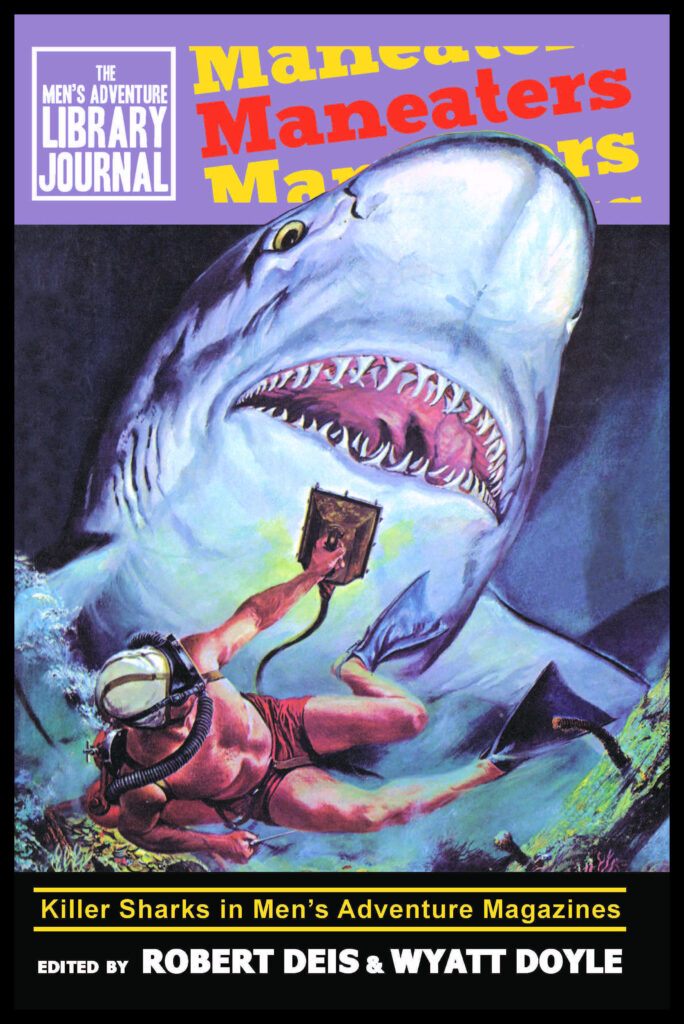
When it’s Shark Week on the Discovery Channel I like to revisit MANEATERS: KILLER SHARKS IN MEN’S ADVENTURE MAGAZINES, one of the books in the Men’s Adventure Library series I co-edit with Wyatt Doyle.
MANEATERS is a lushly illustrated, full-color anthology of classic shark stories from men’s adventure magazines published in the 1950s, 1960s and 1970s.
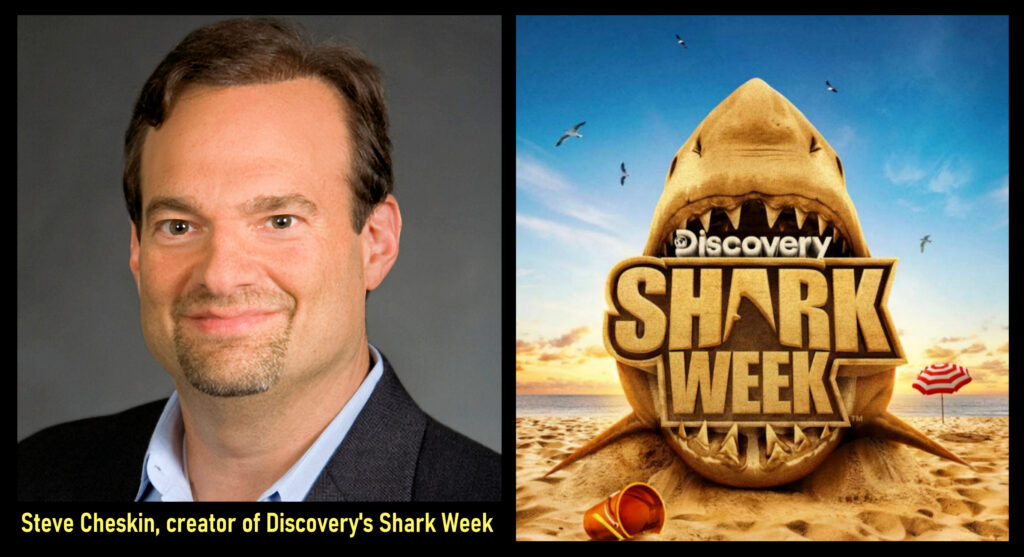
Thanks to Wyatt Doyle’s outreach efforts, the book includes a Foreword by Steve Cheskin—who created the “Shark Week” concept when he worked for Discovery. (He’s now Senior Vice President of Programming at REELZ.)
In his Foreword, Cheskin recalled:
“We were brainstorming at a meeting I’d been invited to join at the last minute. How do we get noticed? How do we get people to notice Discovery?… I knew we had a lot of shark programs, and I knew sharks did really well for us. So I said, “What about doing ‘shark week’? And John Hendricks, founder and president of Discovery, said, ‘That’s it.’”
Shark Week was launched in 1988. For the first few years, many Shark Week shows focused on shark attacks. Since then, as scientists and environmental organizations worked to counter unrealistic anti-shark fears and warn about declining shark populations, more of the programming has focused on shark behavior and conservation.
Nonetheless, Shark Week episodes and movies involving people getting attacked by sharks are still popular.
Like science-fiction monster movies, they’re scary, exciting, bloody—and fun to watch.
The editors of men’s adventure magazines knew that. Bloody man vs. animal stories, usually illustrated with eye-grabbing artwork, were common in MAMs. And, sharks were one of the most common killer creatures in those stories.
Wyatt and I included 16 of our favorite shark stories in the MANEATERS anthology along with the classic painted cover and interior illustrations and photographs used in the stories. There’s also a gallery of shark art by various MAM artists and a special feature about “The Godfather of Pulp Fiction Illustrators” Mort Künstler and the shark paintings he created.
In addition, Wyatt recruited 11 shark experts and marine scientists to write commentaries explaining which aspects of the stories are myths about sharks and shark behavior, which are somewhat true, and which, in a few cases, are accurate.
MANEATERS also has an Afterword by Jack Perez (aka Ace Hannah) writer/director of the 2009 cult flick MEGA SHARK VS. GIANT OCTOPUS, a movie that has some of the same gonzo DNA found in MAM killer critter stories.
I’ve featured some of the stories and artwork in MANEATERS in this post. I’ll show more in following posts, so if you like this one, be sure to subscribe to this blog.
The cover of MANEATERS has a dramatic painting by Phil Ronfor, originally created for the July 1957 issue of ADVENTURE and later reused on the January 1961 cover of FURY.
The Preface I wrote for the book shows the cover of MAN’S CONQUEST, August 1955 (artist uncredited) and the photo spread for the story “The Six Million Killer Sharks That Terrorize Our Shores” in MEN, April 1966. The name of the writer, Mario Cleri, was a pseudonym used by Mario Puzo. Before Puzo became famous as the author of THE GODFATHER in 1969, he was a writer and Associate Editor for MAMs published by Martin Goodman’s Magazine Management Company (MALE, MEN, STAG, etc.).
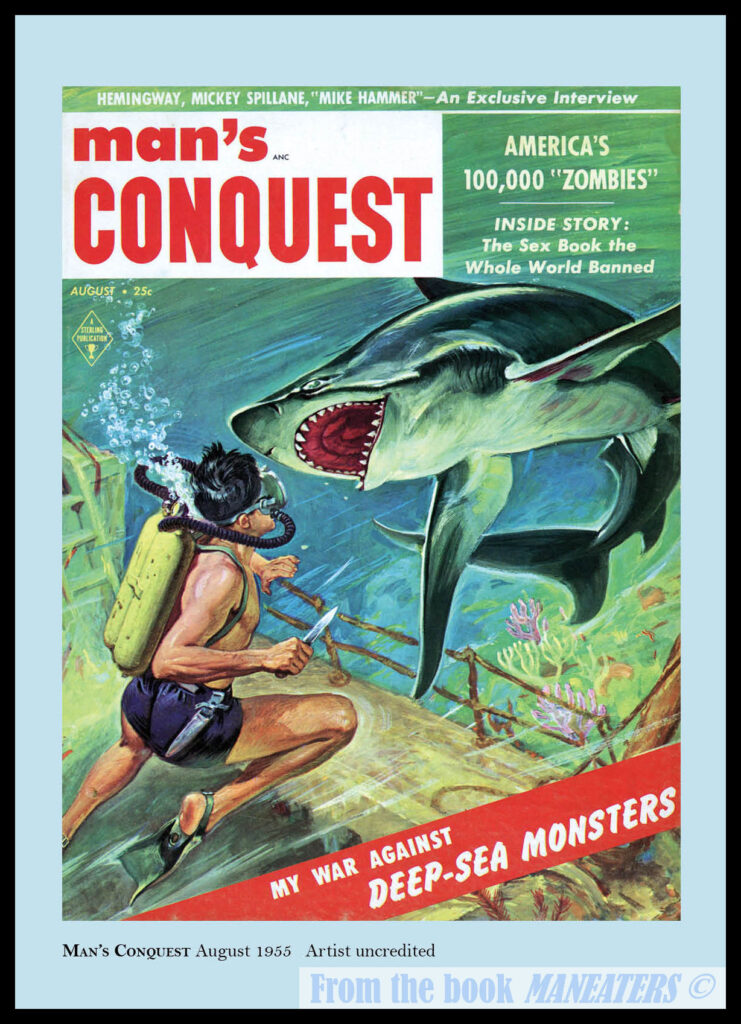

Puzo’s semi-factual article opens with a passage that made me wonder if JAWS author Peter Benchley or JAWS movie director Steven Spielberg might have read the story. It says:
“As carefree summer vacationers frolic on beaches all over America, horrible death waits a few yards off-shore in the maws of giant sharks who’ve developed an insatiable taste for human flesh. But despite a rocketing toll of maimed, crippled, scarred and dead casualties, resort towns everywhere have dropped a blackout curtain on this hideous new menace—preferring to expose millions to death rather than let the frightening truth scare off tourist dollars.”
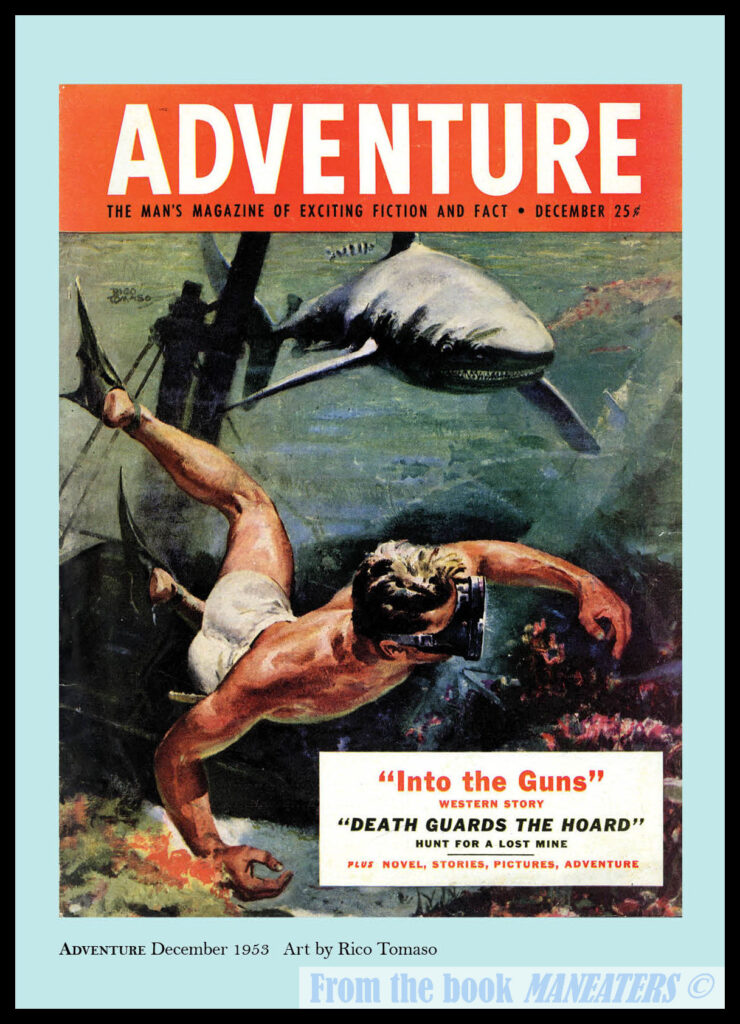
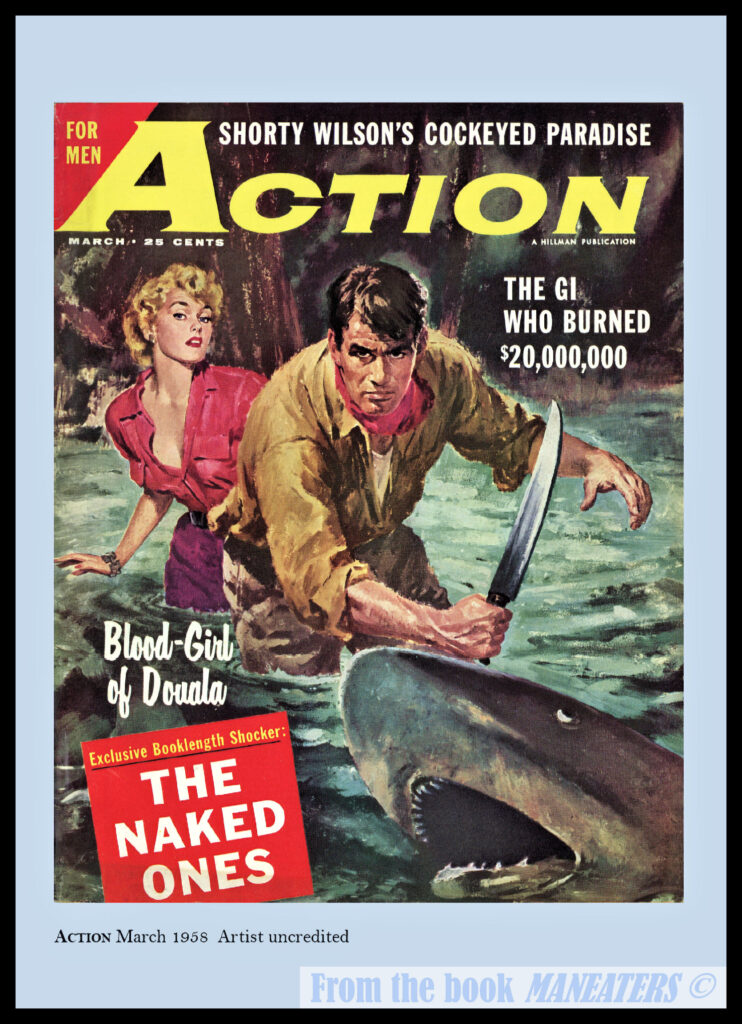
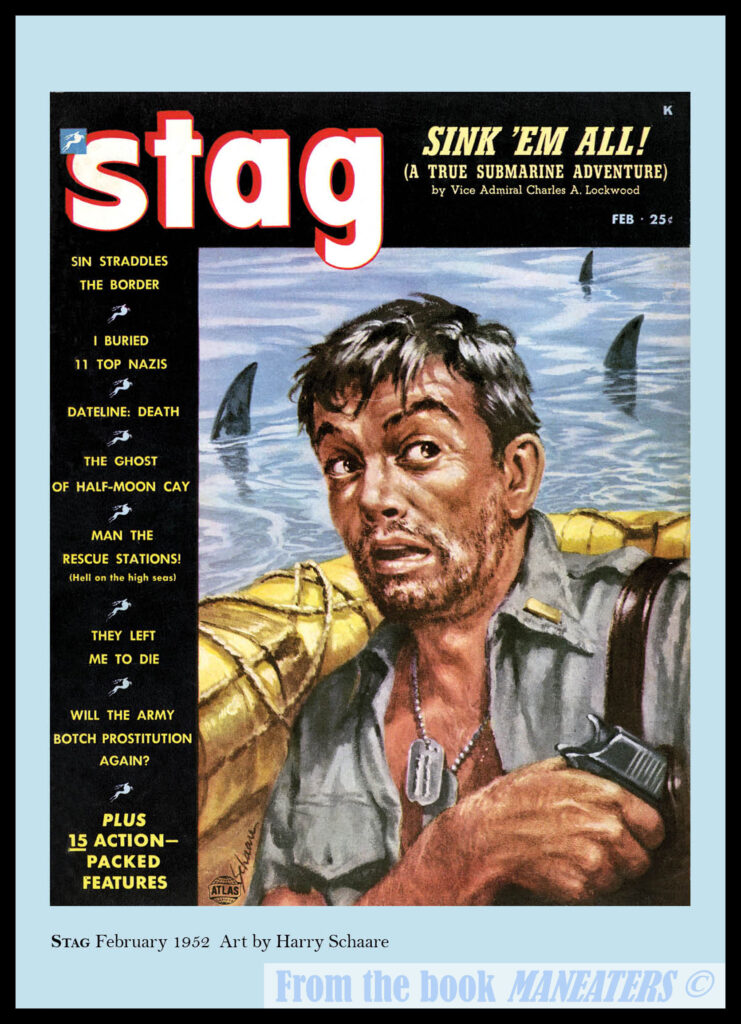
My preface is followed by Wyatt’s essay about shark stories in MAMs, “Death Has Sharp Teeth.” It features three great shark covers: ADVENTURE, December 1953 (art by Rico Tomaso), ACTION, March 1958 (artist uncredited) and STAG, February 1952 (art by Harry Schaare).
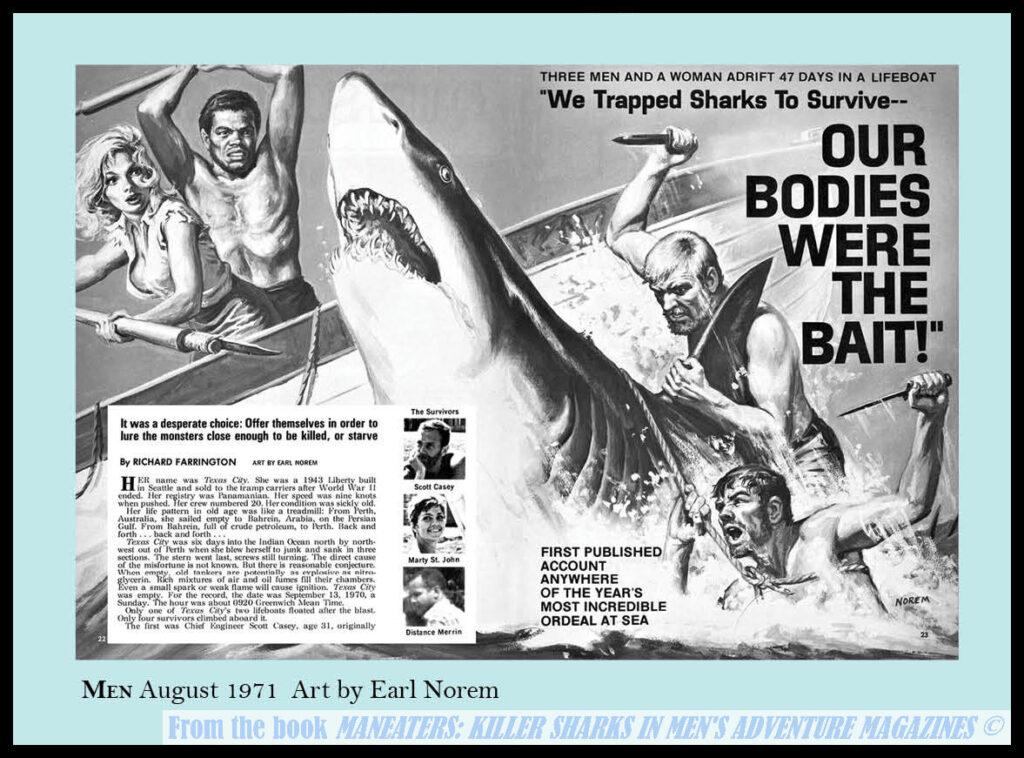
Wyatt’s essay also includes a eye-popping interior illustration by Earl Norem, used for the wild story “Our Bodies Were The Bait” in MEN, August 1971. It’s a classic example of the kind of faux true stories that were perfected by the Magazine Management MAMs. It uses the stock photo trick: adding small headshot photos that are supposedly photos of the people in the story. The author, Richard Farrington (probably a pseudonym) provides specific details that sound credible, such as the name of the boat and the date when it blew up and forced survivors into the ocean. But if you do some searching (as I did), you’ll find there is no historical record of an oil tanker named Texas City or any other boat exploding in the Indian Ocean on September 13, 1970, nor of a 47-day lifeboat survival ordeal involving the people named.
However, I love the story’s central gimmick—starving survivors in a lifeboat offering their own limbs in the water as bait to lure 18-foot sharks close enough to stab with makeshift spears, so they can eat them. It’s creative over-the-top newsstand melodrama that matches Earl Norem’s sensational artwork.
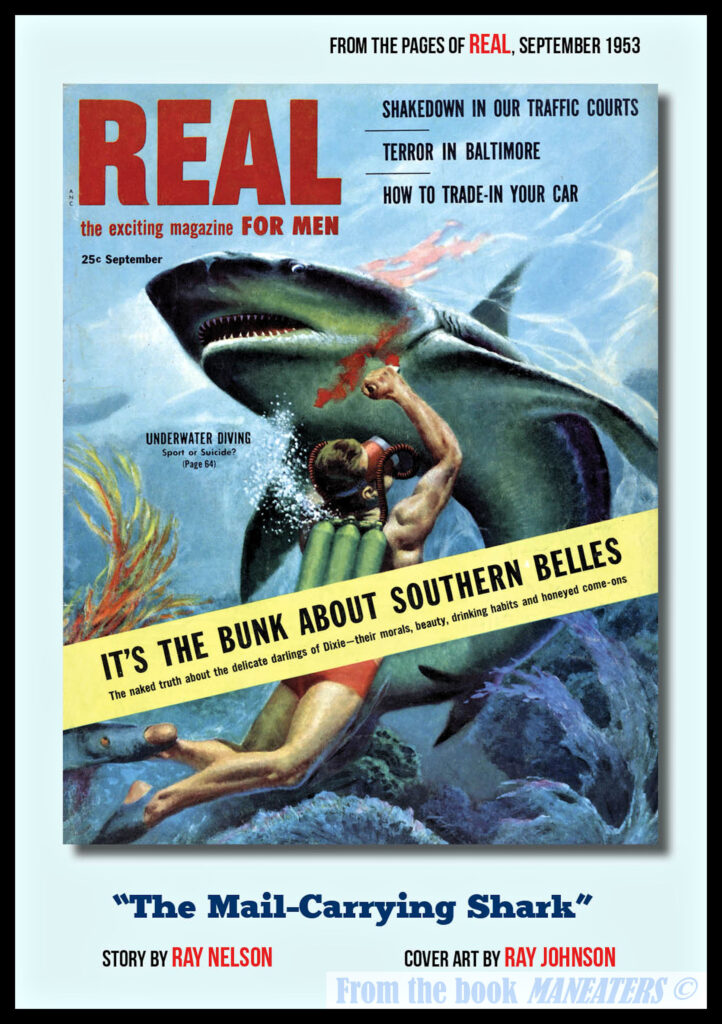
The first story reprinted in full in MANEATERS is “The Mail-Carrying Shark” from REAL, September 1953. You might think the shark painting on the cover goes with that story. But, nope. It’s there to grab eyeballs on newsstands and has nothing to do with the story, a humorous yarn about a shark whose stomach was found to contain a mailbag. “When you get around to it,” says a fisherman at the end, “you might see if there’s any mail for me.”
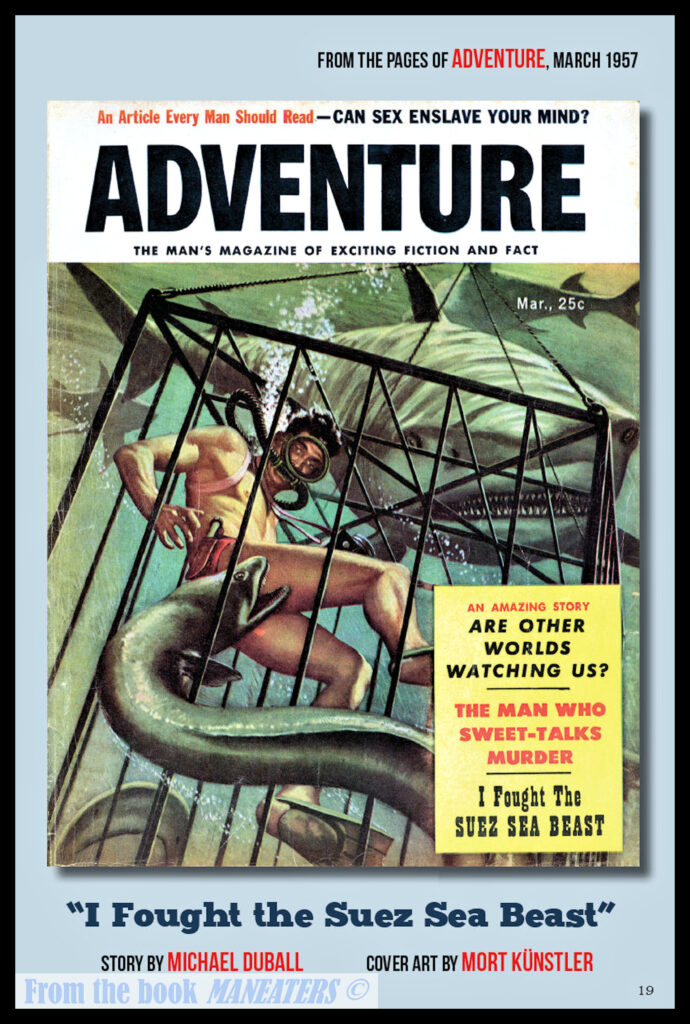
That’s followed by a gripping, supposedly first-hand story titled “I Fought the Suez Sea Beast” from the pages of ADVENTURE, March 1957. In that story, a diver faces both killer sharks and a giant moray eel. The cover of that issue, also used inside with the story, was done by Mort Künstler.
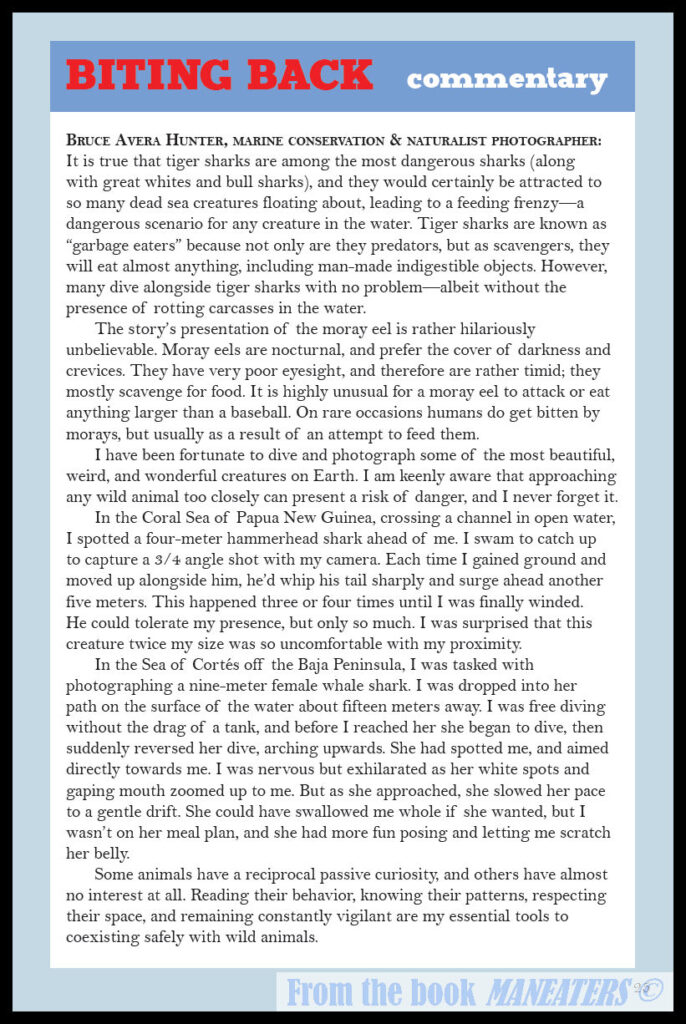
Before we published MANEATERS, Wyatt Doyle contacted a number of marine scientists and other shark experts and asked them to comment on what the stories got right—or wrong—about shark behavior. We included their observations at the end of the stories they reviewed under the heading “Biting Back” Commentary.
Bruce Avera Hunter, a conservationist and photographer who often works for NATIONAL GEOGRAPHIC, wrote the “Biting Back” commentary for the story “I Fought the Suez Sea Beast.” Among other things, he noted: “It is true that tiger sharks are among the most dangerous sharks (along with great whites and bull sharks)… The story’s presentation of the moray eel is rather hilariously unbelievable… On rare occasions humans do get bitten by morays, but usually as a result of an attempt to feed them.”
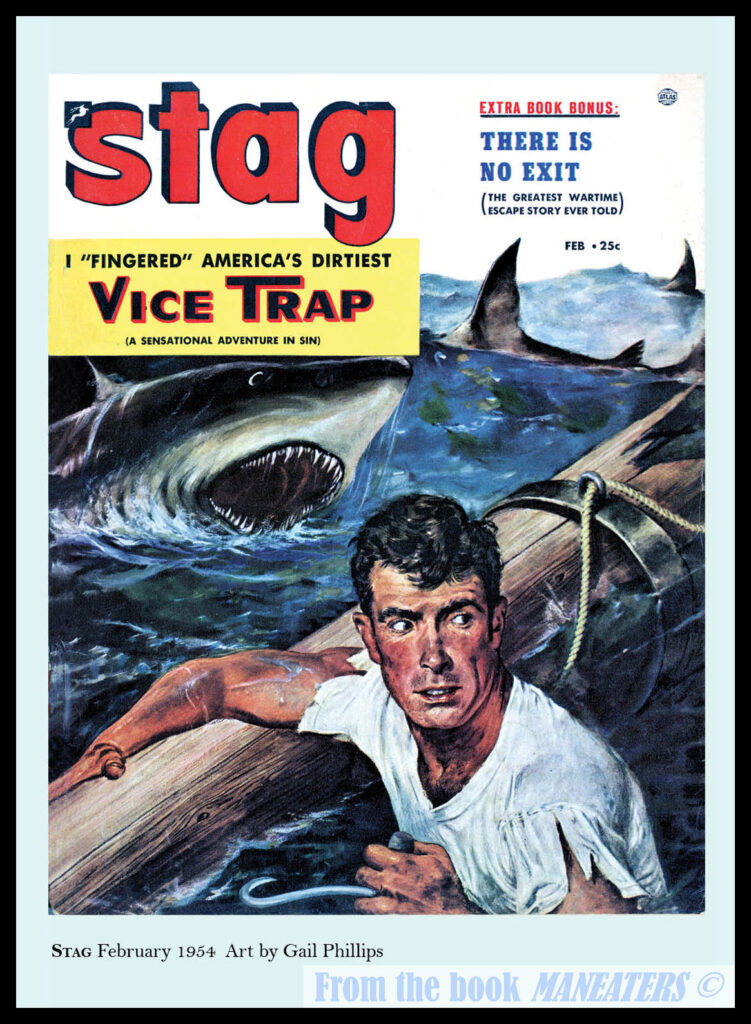
In between that story and the next one is the cover of STAG, February 1954 (art by Gail Phillips). It shows a hapless shipwreck survivor getting ready to try to fight off sharks with a stevedore’s hook. The STAG story is fiction, but as the next story shows, it’s not always easy to know which MAM stories are based on fact and which are pure pulp fiction.
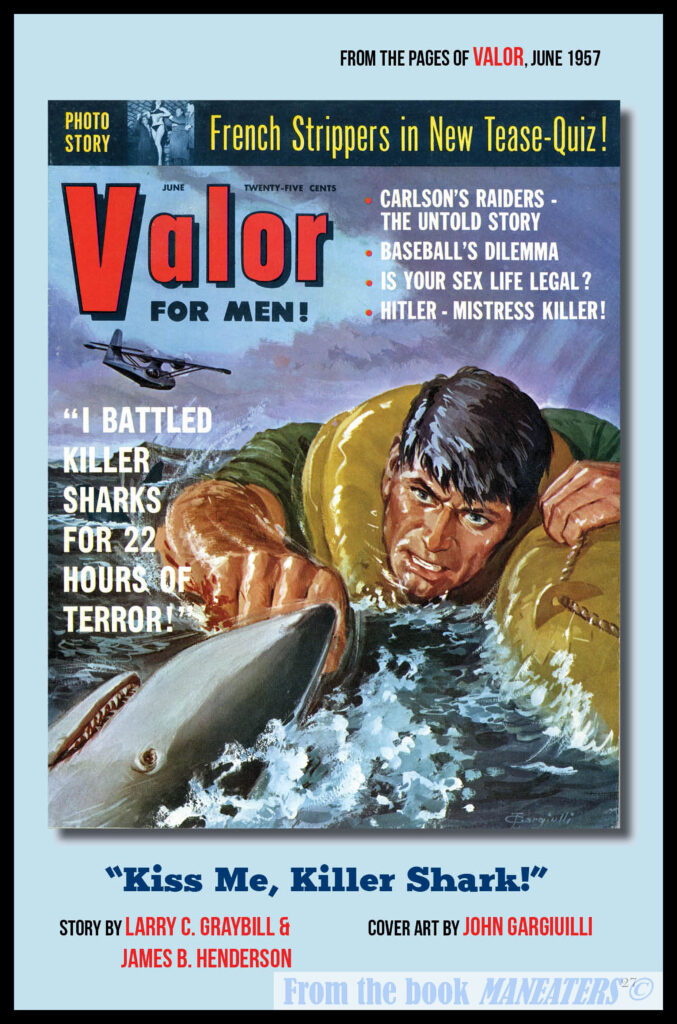
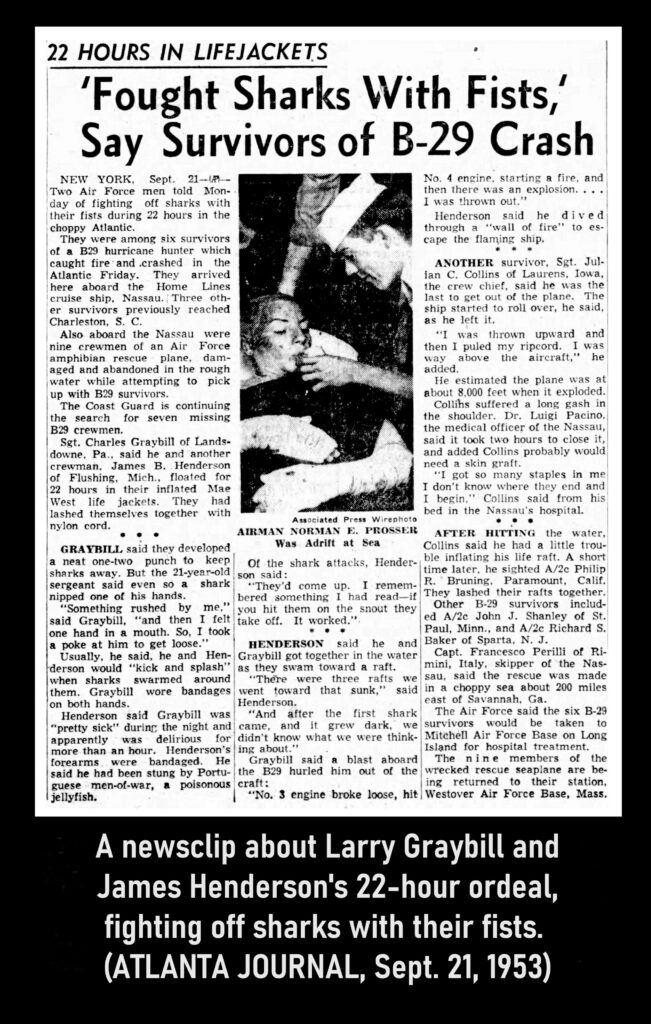
That next story is titled “Kiss Me, Killer Shark!” It was published in the lesser known MAM VALOR in June 1957, with art by John Gargiulli. It is indeed a true story, told by Sergeant Larry C. Graybill and Airman Second Class James B. Henderson.
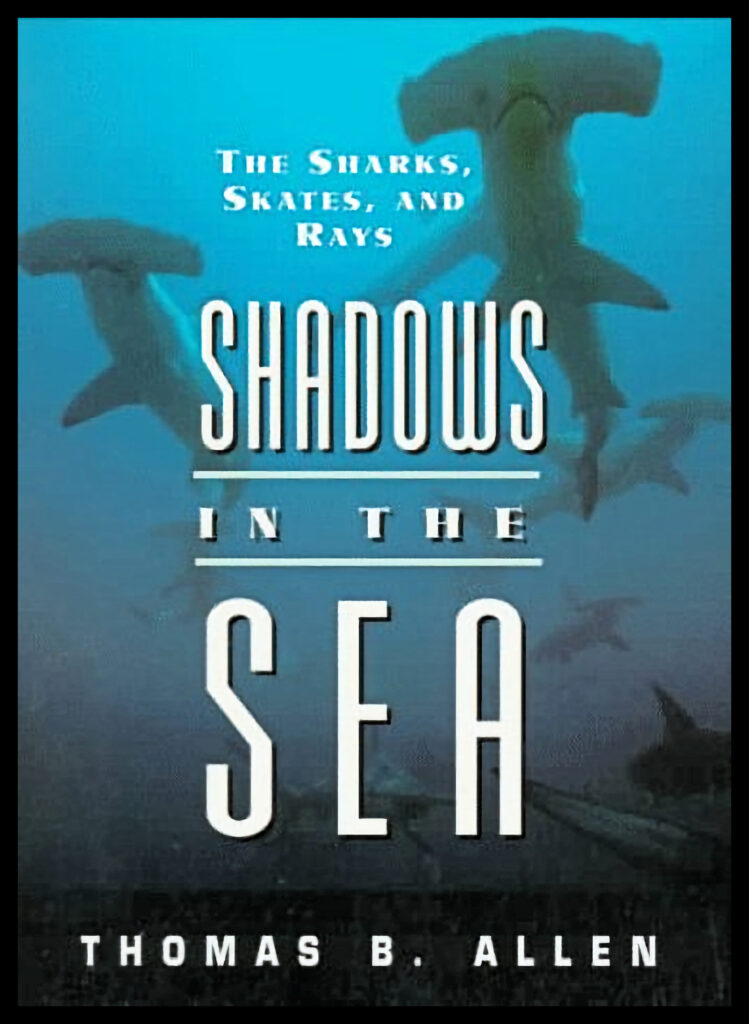
Graybill and Henderson were forced to parachute out of a burning WB-29 weather reconnaissance aircraft into the Atlantic about 200 miles east of Savannah, Georgia in 1953. As recounted in news stories published when they were rescued and in the non-fiction book, SHADOWS IN THE SEA (1962), they fought off sharks with their fists for 22 hours before they were picked up. Their hands were cut and scraped by sharks and Henderson’s forearms were raw with Portuguese men-of-war stings. But they lived to tell the tale, and it was a perfect fit for a men’s adventure magazine.
I’ll show some more of the stories and artwork from MANEATERS: KILLER SHARKS IN MEN’S ADVENTURE MAGAZINES in my next post here.
In the meantime, you can dive deeper into vintage men’s pulp mag shark lore by ordering a copy of MANEATERS in hardcover or softcover from Amazon or the MensPulpMags.com bookstore.
* * * * * * * *
Comments? Corrections? You can email them to me, or join the Men’s Adventure Magazines & Books Facebook Group or the MEN’S ADVENTURE QUARTERLY BRIGADE group and post them there.



RECOMMENDED READING, LISTENING AND VIEWING RELATED TO THIS POST…


