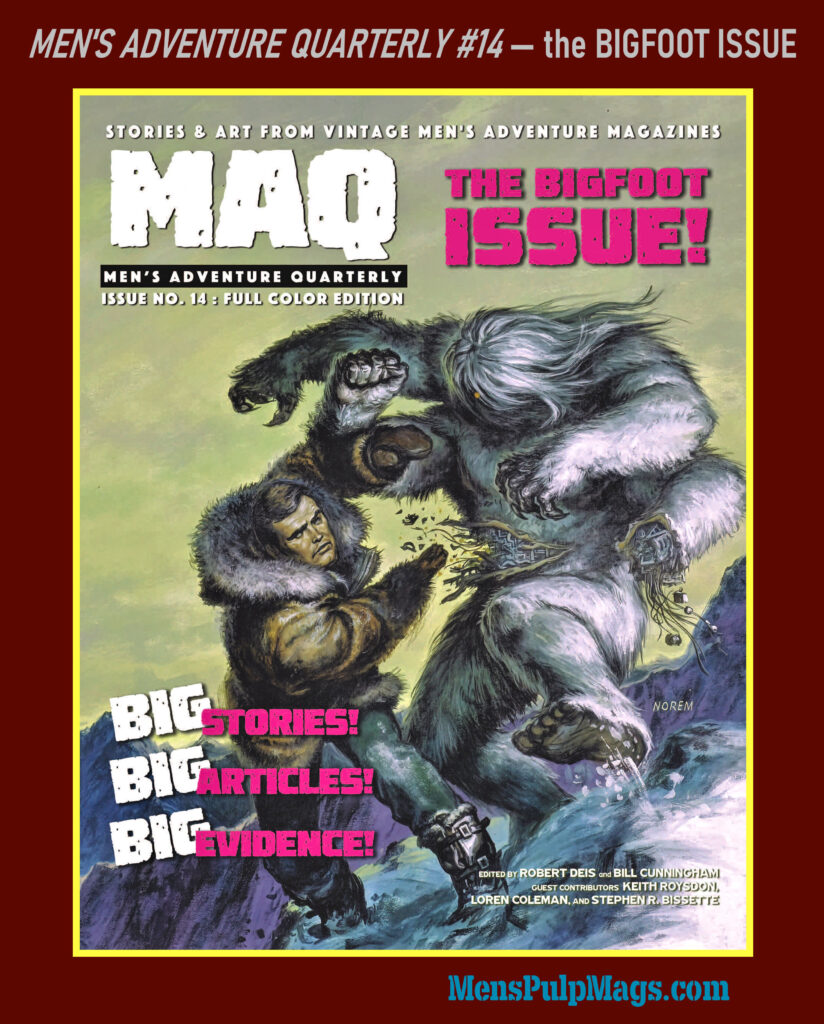
In a previous post here, I announced the release of MEN’S ADVENTURE QUARTERLY #14, the BIGFOOT ISSUE. It’s now available on Amazon worldwide.
You can also get copies directly from me via my MensPulpMags.com bookstore or my eBay listings.
MAQ #14 includes reprints of some classic men’s adventure magazine stories and artwork featuring Bigfoot and other hominid cryptids, plus articles about Bigfoot in movies, books, comics, and TV shows by cryptozoologist Loren Coleman, writer and artist Stephen R. Bissette, author Keith Roysdon, and more.
The “more” includes lushly illustrated special features by MAQ co-editor Bill Cunningham and introductions by me that delve into the backgrounds of the MAM stories we reprinted.
The name Sasquatch predates the name Bigfoot by several decades. Stories about hairy wildmen called by that name were first popularized by newspaper and magazine articles written by John W. Burns, starting in the late 1920s.
Burns was an Indigenous school teacher and government Indian agent in British Columbia from the mid-1920s to the mid-1940s. We reprinted a version of one of his stories in MAQ #14.
The name “Bigfoot” was initially launched into public awareness by a series of newspaper reports about huge manlike footprints in the Bluff Creek area of California in the fall of 1958.
That’s the same area where Roger Patterson and Bob Gimlin shot their famed film of what appears to be a female Bigfoot in 1967. (As I noted in the Afterword of MAQ #14, a recently released documentary titled CAPTURING BIGFOOT has created a major new firestorm of controversy over whether the Patterson-Gimlin film was faked.)
The first in-depth article about the 1958 Bigfoot reports published in a national magazine appeared in the December 1959 issue of TRUE. Titled “The Strange Story of America’s Abominable Snowman,” it’s one of the MAM stories we reprinted in MAQ #14.
That story was written by Ivan T. Sanderson—a trained zoologist who became one of the best-known writers of stories about cryptid creatures.
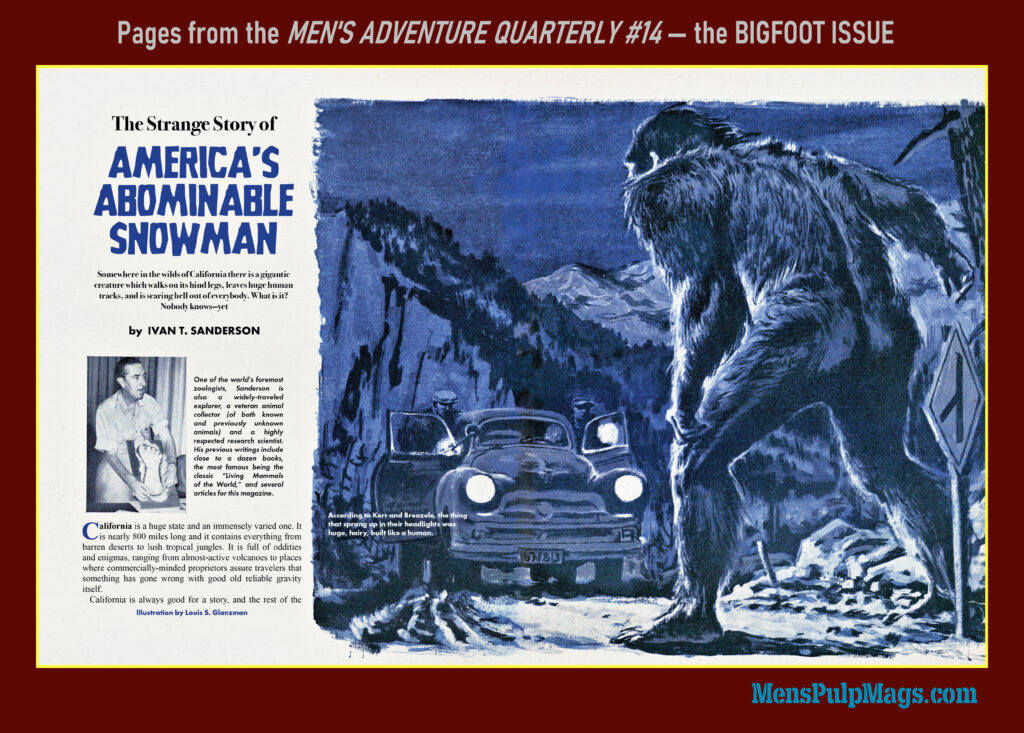
His 1957 book ABOMINABLE SNOWMEN: LEGEND COME TO LIFE was the first serious, systematic study of reports of the Yeti, Sasquatch, and similar “hairy hominids” from countries around the world.
Sanderson wrote many articles about various cryptids for magazines. Dozens appeared in men’s adventure magazines—especially ARGOSY and TRUE, two of the top-tier, high-circulation MAMs.
Not long after stories about the Bluff Creek footprints hit the news in 1958, Sanderson traveled to California to interview loggers and other local residents who said they’d seen footprints and other evidence of a large mysterious creature.
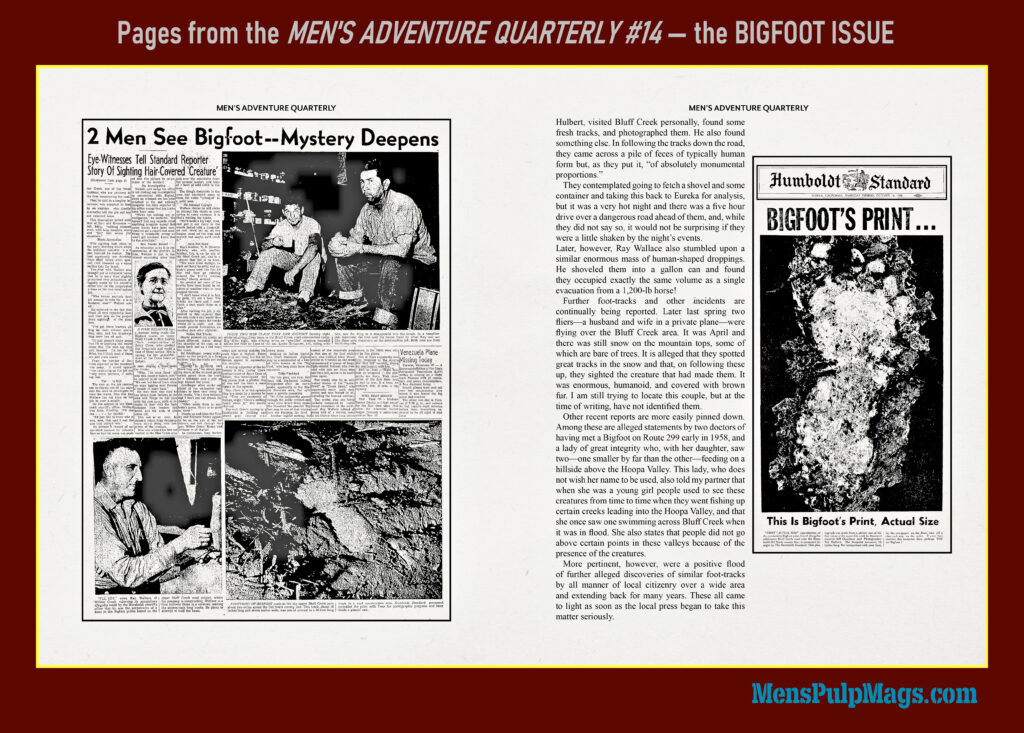
The article he wrote for TRUE recounts what he learned during that investigation. Near the end of that article, he briefly mentions historic accounts of a giant “Indian-Negro-White man” in Idaho who had abnormally large feet.
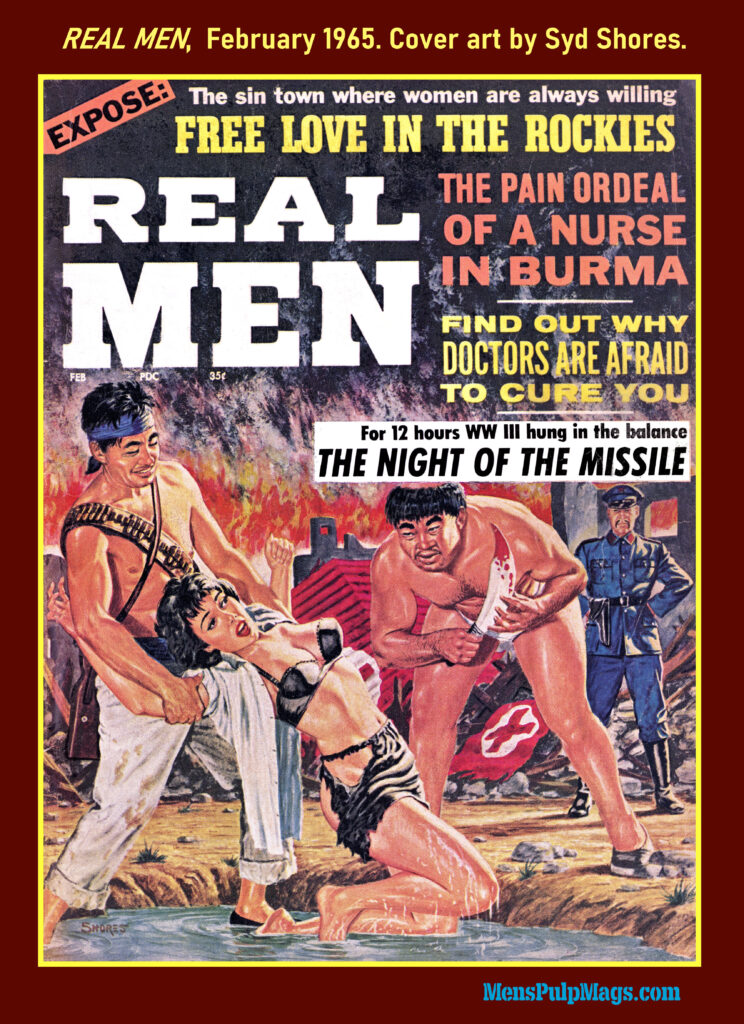
Oddly, he doesn’t mention that Idaho settlers called that man “Bigfoot.” But Sanderson’s mention reminded me that there’s a story about the Idaho Bigfoot in the February 1965 issue of the men’s adventure magazine REAL MEN, titled “Kill the Mad Giant of Idaho.”
It’s a wild account of how a bounty hunter named John Wheeler tracked down and killed a huge mixed-breed outlaw white settlers called “Bigfoot” in 1868. The story is based on a historic but highly sensationalized newspaper article published in the IDAHO STATESMAN in 1878.
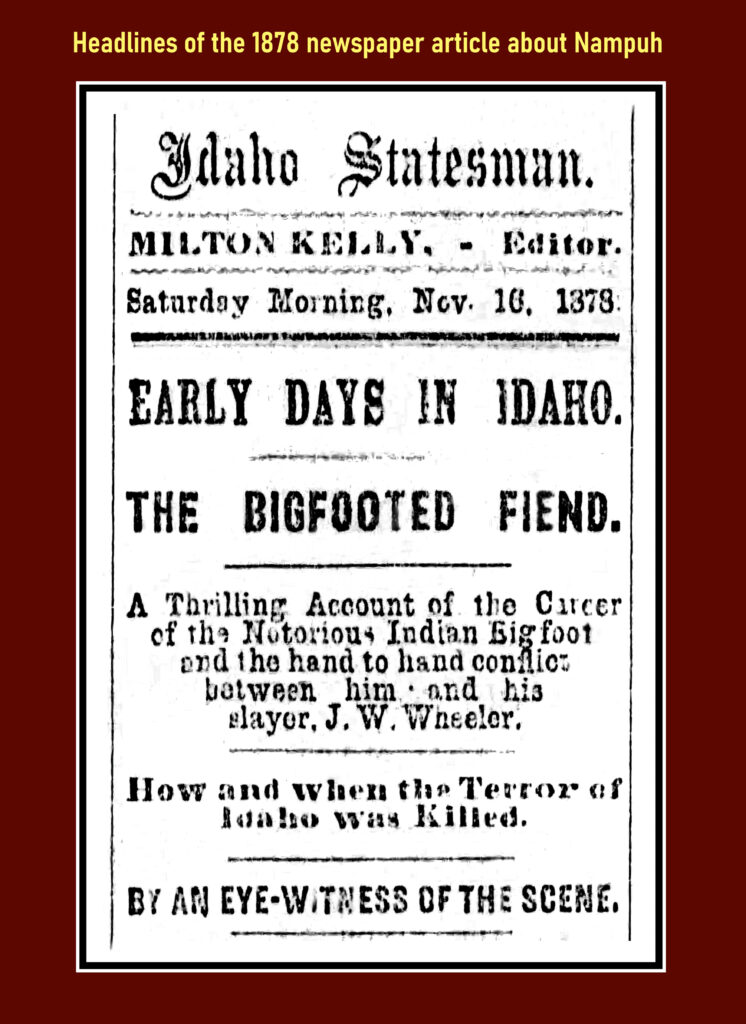
Indians called the giant Nampuh (also spelled Nampa), a Shoshone word meaning “foot” or “footprint,” and according to newspaper accounts, he referred to himself by that name.
He was believed to be half white, a quarter Cherokee, and a quarter African-American. White settlers converted his Indian name into “Bigfoot.” His birth name was said to be Starr Wilkinson.
During the 1860s, Nampuh was blamed for a series of attacks on stagecoaches and ranches and for many bloody murders. He was described as nearly seven feet tall, massively built, and capable of outrunning horses across rugged terrain.
His feet were said to measure 17 to 17 1/2 inches long—coincidentally the same size as the famed footprints said to be made by the Bluff Creek Bigfoot.
The story in REAL MEN mistakenly suggests that Nampuh was a Paiute (misspelled as Piute). Told in lurid men’s adventure style, the story blends quasi-historical facts and frontier legend with pulp-style exaggeration.
In the dramatic climax, Wheeler shoots 16 rifle bullets into Nampuh’s body in a close-range gun battle, then listens to Nampuh’s final words as the big man lays dying.
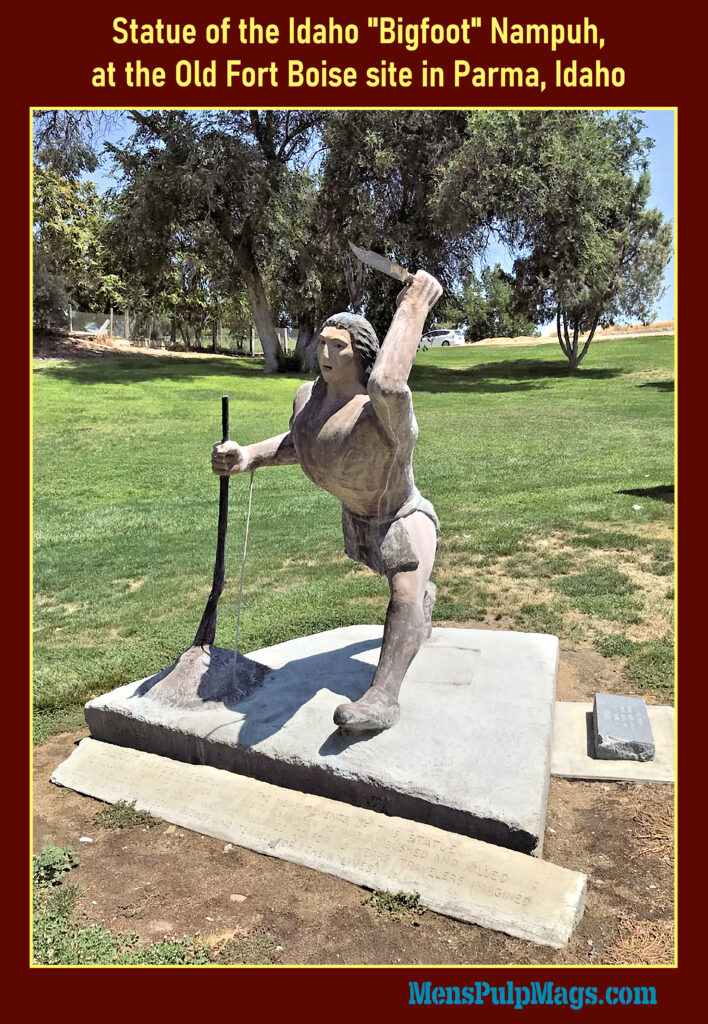
Newspaper articles about Nampuh and his bloody end became legendary in Idaho. Today there’s a concrete statue of him in Parma, at the Old Fort Boise Replica and Museum site.
The nearby city of Nampa, established in the mid-1880s, is generally said to take its name from “Nampuh.”
Local tradition links the name to the giant outlaw, though it may simply be a place name based on the Shoshone word for “foot.”
The inscription on the statue in Parma says: “Bigfoot was a gigantic outlaw with the same measurements as this statue. He killed and terrified this area from 1856 to 1868, when he was ambushed and killed with 16 bullets. His death was not reported for 10 years. Travelers imagined they saw him hiding in the bushes and feared for their lives.”
I wrote a sidebar about Nampuh that’s in the MEN’S ADVENTURE QUARTERLY #14, but we didn’t have room to reprint the REAL MEN story. So, I decided to reprint the story here on my blog.
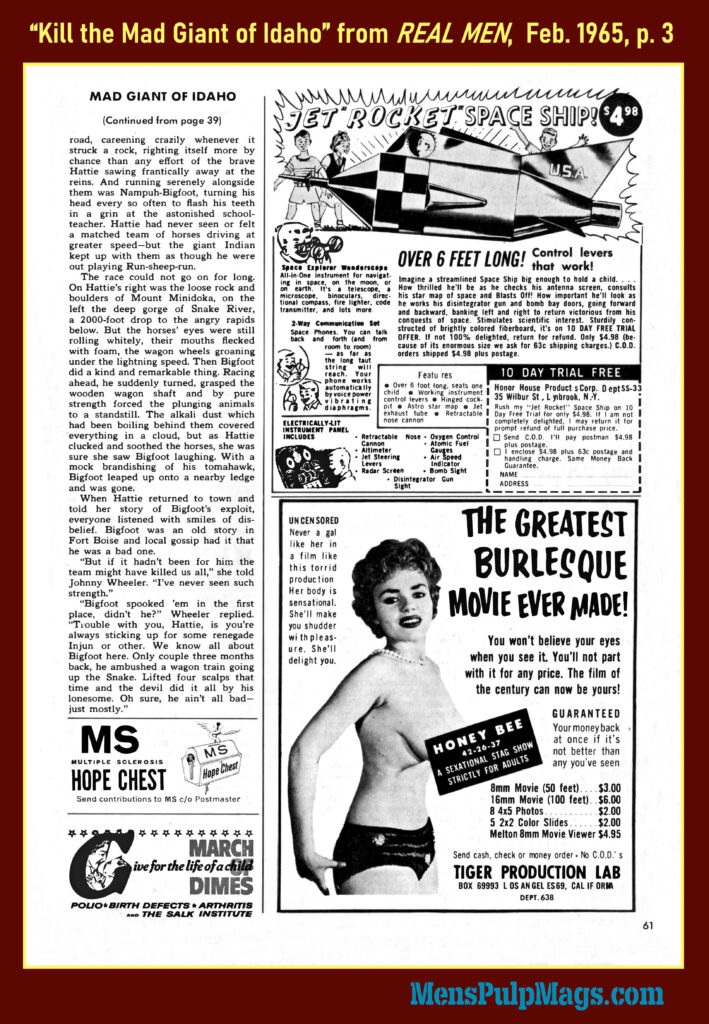
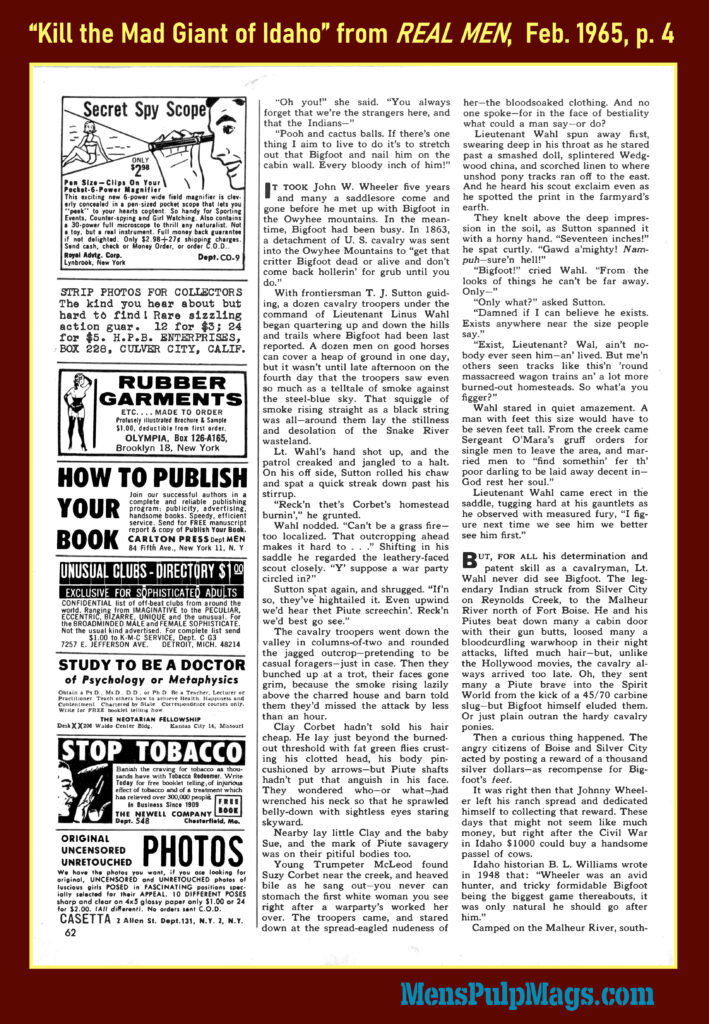
The full text is shown below, along with scans of all the pages, so you can see both the 2-page spread and the classic ads on each of the pages. Like most MAM ads, they are entertaining reading in themselves.
* * * * *
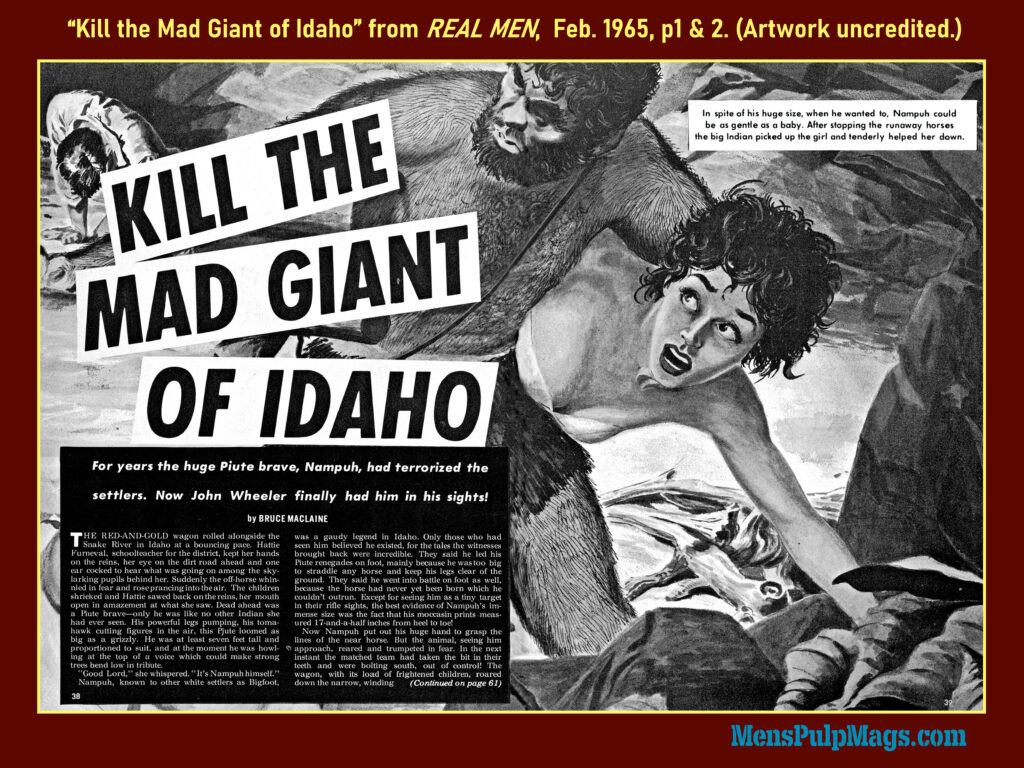
“Kill the Mad Giant of Idaho” from REAL MEN, February 1965 by Bruce MacLaine
THE RED-AND-GOLD wagon rolled alongside the Snake River in Idaho at a bouncing pace. Hattie Furneval, schoolteacher for the district, kept her hands on the reins, her eye on the dirt road ahead and one ear cocked to hear what was going on among the skylarking pupils behind her. Suddenly the off-horse whinnied in fear and rose prancing into the air. The children shrieked and Hattie sawed back on the reins, her mouth open in amazement at what she saw. Dead ahead was a Piute brave—only he was like no other Indian she had ever seen. His powerful legs pumping, his tomahawk cutting figures in the air, this Piute loomed as big as a grizzly. He was at least seven feet tall and proportioned to suit, and at the moment he was howling at the top of a voice which could make strong trees bend low in tribute.
“Good Lord,” she whispered. “It’s Nampuh himself.”
Nampuh, known to other white settlers as Bigfoot, was a gaudy legend in Idaho. Only those who had seen him believed he existed, for the tales the witnesses brought back were incredible. They said he led his Piute renegades on foot, mainly because he was too big to straddle any horse and keep his legs clear of the ground. They said he went into battle on foot as well, because the horse had never yet been born which he couldn’t outrun. Except for seeing him as a tiny target in their rifle sights, the best evidence of Nampuh’s immense size was the fact that his moccasin prints measured 17-and-a-half inches from heel to toe!
Now Nampuh put out his huge hand to grasp the lines of the near horse. But the animal, seeing him approach, reared and trumpeted in fear. In the next instant the matched team had taken the bit in their teeth and were bolting south, out of control! The wagon, with its load of frightened children, roared down the narrow, winding road, careening crazily whenever it struck a rock, righting itself more by chance than any effort of the brave Hattie sawing frantically away at the reins. And running serenely alongside them was Nampuh-Bigfoot, turning his head every so often to flash his teeth in a grin at the astonished schoolteacher. Hattie had never seen or felt a matched team of horses driving at greater speed—but the giant Indian kept up with them as though he were out playing Run-sheep-run.
The race could not go on for long. On Hattie’s right was the loose rock and boulders of Mount Minidoka, on the left the deep gorge of Snake River, a 2000-foot drop to the angry rapids below. But the horses’ eyes were still rolling whitely, their mouths flecked with foam, the wagon wheels groaning under the lightning speed. Then Bigfoot did a kind and remarkable thing. Racing ahead, he suddenly turned, grasped the wooden wagon shaft and by pure strength forced the plunging animals to a standstill. The alkali dust which had been boiling behind them covered everything in a cloud, but as Hattie clucked and soothed the horses, she was sure she saw Bigfoot laughing. With a mock brandishing of his tomahawk, Bigfoot leaped up onto a nearby ledge and was gone.
When Hattie returned to town and told her story of Bigfoot’s exploit, everyone listened with smiles of disbelief. Bigfoot was an old story in Fort Boise and local gossip had it that he was a bad one.
“But if it hadn’t been for him the team might have killed us all,” she told Johnny Wheeler. “I’ve never seen such strength.”
“Bigfoot spooked ’em in the first place, didn’t he?” Wheeler replied. “Trouble with you, Hattie, is you’re always sticking up for some renegade Injun or other. We know all about Bigfoot here. Only couple three months back, he ambushed a wagon train going up the Snake. Lifted four scalps that time and the devil did it all by his lonesome. Oh sure, he ain’t all bad—just mostly.”
“‘Oh you!” she said. “You always forget that we’re the strangers here, and that the Indians—”
“Pooh and cactus balls. If there’s one thing I aim to live to do it’s to stretch out that Bigfoot and nail him on the cabin wall. Every bloody inch of him!”
IT TOOK John W. Wheeler five years and many a saddlesore come and gone before he met up with Bigfoot in the Owyhee mountains. In the meantime, Bigfoot had been busy. In 1863, a detachment of U. S. cavalry was sent into the Owyhee Mountains to “get that critter Bigfoot dead or alive and don’t come back hollerin’ for grub until you do.”
With frontiersman T. J. Sutton guiding, a dozen cavalry troopers under the command of Lieutenant Linus Wahl began quartering up and down the hills and trails where Bigfoot had been last reported. A dozen men on good horses can cover a heap of ground in one day, but it wasn’t until late afternoon on the fourth day that the troopers saw even so much as a telltale of smoke against the steel-blue sky. That squiggle of smoke rising straight as a black string was all around them lay the stillness and desolation of the Snake River wasteland.
Lt. Wahl’s hand shot up, and the patrol creaked and jangled to a halt. On his off side, Sutton rolled his chaw and spat a quick streak down past his stirrup.
“Reck’n thet’s Corbet’s homestead burnin’,” he grunted.
Wahl nodded. “Can’t be a grass fire—too localized. That outcropping ahead makes it hard to…” Shifting in his saddle he regarded the leathery-faced scout closely. “Y’ suppose a war party circled in?”
Sutton spat again and shrugged. “If’n so, they’ve· hightailed it. Even upwind we’d hear thet Piute screechin’. Reck’n we’d best go see.”
The cavalry troopers went down the valley in columns-of-two and rounded the jagged outcrop-pretending to be casual foragers-just in case. Then they bunched up at a trot, their faces gone grim, because the smoke rising lazily above the charred house and barn told them they’d missed the attack by less than an hour.
Clay Corbet hadn’t sold his hair cheap. He lay just beyond the burnedout threshold with fat green flies crusting his clotted head, his body pincushioned by arrows—but Piute shafts hadn’t put that anguish in his face. They wondered who—or what—had wrenched his neck so that he sprawled belly-down with sightless eyes staring skyward.
Nearby lay little Clay and the baby Sue, and the mark of Piute savagery was on their pitiful bodies too.
Young Trumpeter McLeod .found Suzy Corbet near the creek, and heaved bile as he sang out—you never can stomach the first white woman you see right after a warparty’s worked her over. The troopers came and stared down at the spread-eagled nudeness of her—the blood-soaked clothing. And no one spoke-for in the face of bestiality what could a man say-or do?
Lieutenant Wahl spun away first, swearing deep in his throat as he stared past a smashed doll, splintered Wedgwood china, and scorched linen to where unshod pony tracks ran off to the east. And he heard his scout exclaim even as he spotted the print in the farmyard’s earth.
They knelt above the deep impression in the soil, as Sutton spanned it with a horny hand. “Seventeen inches!” he spat curtly. “Gawd a’mighty! Nampuh—sure’n hell!”
“Bigfoot!” cried Wahl. “From the looks of things he can’t be far away. Only—”
“Only what?” asked Sutton.
“Damned if I can believe he exists. Exists anywhere near the size people say.”
“Exist, Lieutenant? Wal, ain’t nobody ever seen him-an’ lived. But me’n others seen tracks like this’n ’round massacreed wagon trains an’ a lot more burned-out homesteads. So what’a you figger?”
Wahl stared in quiet amazement. A man with feet this size would have to be seven feet tall. From the creek came Sergeant O’Mara’s gruff orders for single men to leave the area, and married men to “find somethin’ fer th’ poor darling to be laid away decent in—God rest her soul.”
Lieutenant Wahl came erect in the saddle, tugging hard at his gauntlets as he observed with measured fury, “I figure next time we see him we better see him first.”
BUT FOR ALL his determination and patent skill as a cavalryman, Lt. Wahl never did see Bigfoot. The legendary Indian struck from Silver City on Reynolds Creek, to the Malheur River north of Fort Boise. He and his Piutes beat down many a cabin door with their gun butts, loosed many a bloodcurdling war whoop in their night attacks, lifted much hair-but, unlike the Hollywood movies, the cavalry always arrived too late. Oh, they sent many a Piute brave into the Spirit World from the kick of a 45/70 carbine slug-but Bigfoot himself eluded them. Or just plain outran the hardy cavalry ponies.
Then a curious thing happened. The angry citizens of Boise and Silver City acted by posting a reward of a thousand silver dollars—as recompense for Bigfoot’s feet.
It was right then that Johnny Wheeler left his ranch spread and dedicated himself to collecting that reward. These days that might not seem like much money, but right after the Civil War in Idaho $1000 could buy a handsome passel of cows.
Idaho historian B. L. Williams wrote in 1948 that: “Wheeler was an avid hunter, and tricky formidable Bigfoot being the biggest game thereabouts, it was only natural he should go after him.”
Camped on the Malheur River, southwest of today’s Ontario, Oregon, Johnny Wheeler, Ben Cook, and Frank Johnston were aroused at dawn by noises near their tethered horses. But with whoops of defiance, three Indians took off downstream. The hunters blazed angrily away-missing. “Saddle up,” barked Wheeler. “We’ll get’m!”
It was a breakneck chase through dense undergrowth, with every tree an ambush site. Then, across a clearing, they spotted their quarry; two Piutes hard down on racing ponies—and Bigfoot sprinting out ahead! Soon reported the Idaho Statesman they rode down the Piutes. But not Bigfoot!
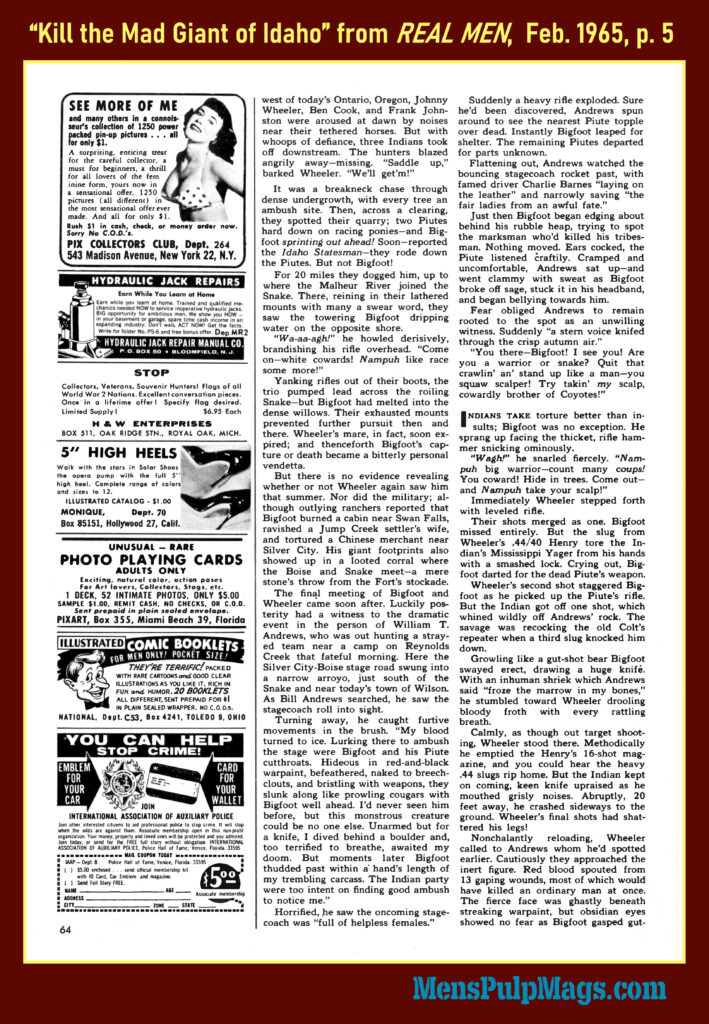
For 20 miles they dogged him, up to where the Malheur River joined the Snake. There, reining in their lathered mounts with many a swear word, they saw the towering Bigfoot dripping water on the opposite shore.
“Wa-aa-agh!” he howled derisively, brandishing his rifle overhead. “Come on-white cowards! Nampuh like race some more!”
Yanking rifles out of their boots, the trio pumped lead across the roiling Snake-but Bigfoot had melted into the dense willows. Their exhausted mounts prevented further pursuit then and there. Wheeler’s mare, in fact, soon expired; and thenceforth Bigfoot’s capture or death became a bitterly personal vendetta.
But there is no evidence revealing whether or not Wheeler again saw him that summer. Nor did the military; although outlying ranchers reported that Bigfoot burned a cabin near Swan Falls, ravished a Jump Creek settler’s wife, and tortured a Chinese merchant near Silver City. His giant footprints also showed up in a looted corral where the Boise and Snake meet-a mere stone’s throw from the Fort’s stockade.
The final meeting of Bigfoot and Wheeler came soon after. Luckily posterity had a witness to the dramatic event in the person of William T. Andrews, who was out hunting a strayed team near a camp on Reynolds Creek that fateful morning. Here the Silver City-Boise stage road swung into a narrow arroyo, just south of the Snake and near today’s town of Wilson. As Bill Andrews searched, he saw the stagecoach roll into sight.
Turning away, he caught furtive movements in the brush. “My blood turned to ice. Lurking there to ambush the stage were Bigfoot and his Piute cutthroats. Hideous in red-and-black warpaint, befeathered, naked to breechclouts, and bristling with weapons, they slunk along like prowling cougars with Bigfoot well ahead. I’d never seen him before, but this monstrous creature could be no one else. Unarmed but for a knife, I had dived behind a boulder and, too terrified to breathe, awaited my doom. But moments later Bigfoot thudded past within a· hand’s length of my trembling carcass. The Indian party were too intent on finding good ambush to notice me.”
Horrified, he saw the oncoming stagecoach was “full of helpless females.”
Suddenly a heavy rifle exploded. Sure he’d been discovered, Andrews spun around to see the nearest Piute topple over dead. Instantly Bigfoot leaped for shelter. The remaining Piutes departed for parts unknown.
Flattening out, Andrews watched the bouncing stagecoach rocket past, with famed driver Charlie Barnes “laying on the leather” and narrowly saving “the fair ladies from an awful fate.”
Just then Bigfoot began edging about behind his rubble heap, trying to spot the marksman who’d killed his tribesman. Nothing moved. Ears cocked, the Piute listened craftily. Cramped and uncomfortable, Andrews sat up and went clammy with sweat as Bigfoot broke off sage, stuck it in his headband, and began bellying towards him.
Fear obliged Andrews to remain rooted to the spot as an unwilling • witness. Suddenly “a stern voice knifed through the crisp autumn air.”
“You there—Bigfoot! I see you! Are you a warrior or snake? Quit that crawlin’ an’ stand up like a man, you squaw scalper! Try takin’ my scalp, cowardly brother of Coyotes!”
INDIANS TAKE torture better than insults; Bigfoot was no exception. He sprang up facing the thicket, rifle hammer snicking ominously.
“Wagh!” he snarled fiercely. “Nampuh big warrior-count many coups! You coward! Hide in trees. Come out—and Nampuh take your scalp!”
Immediately Wheeler stepped forth with leveled rifle.
Their shots merged as one. Bigfoot missed entirely. But the slug from Wheeler’s .44/40 Henry tore the Indian’s Mississippi Yager from his hands with a smashed lock. Crying out, Bigfoot darted for the dead Piute’s weapon.
Wheeler’s second shot staggered Bigfoot as he picked up the Piute’s rifle. But the Indian got off one shot, which whined wildly off Andrews’ rock. The savage was recocking the old Colt’s repeater when a third slug knocked him down.
Growling like a gut-shot bear Bigfoot swayed erect, drawing a huge knife. With an inhuman shriek which Andrews said “froze the marrow in my bones,” he stumbled toward Wheeler drooling bloody froth with every rattling breath.
Calmly, as though out target shooting, Wheeler stood there. Methodically he emptied the Henry’s 16-shot magazine, and you could hear the heavy .44 slugs rip home. But the Indian kept on coming, keen knife upraised as he mouthed grisly noises. Abruptly, 20 feet away, he crashed sideways to the ground. Wheeler’s final shots had shattered his legs!
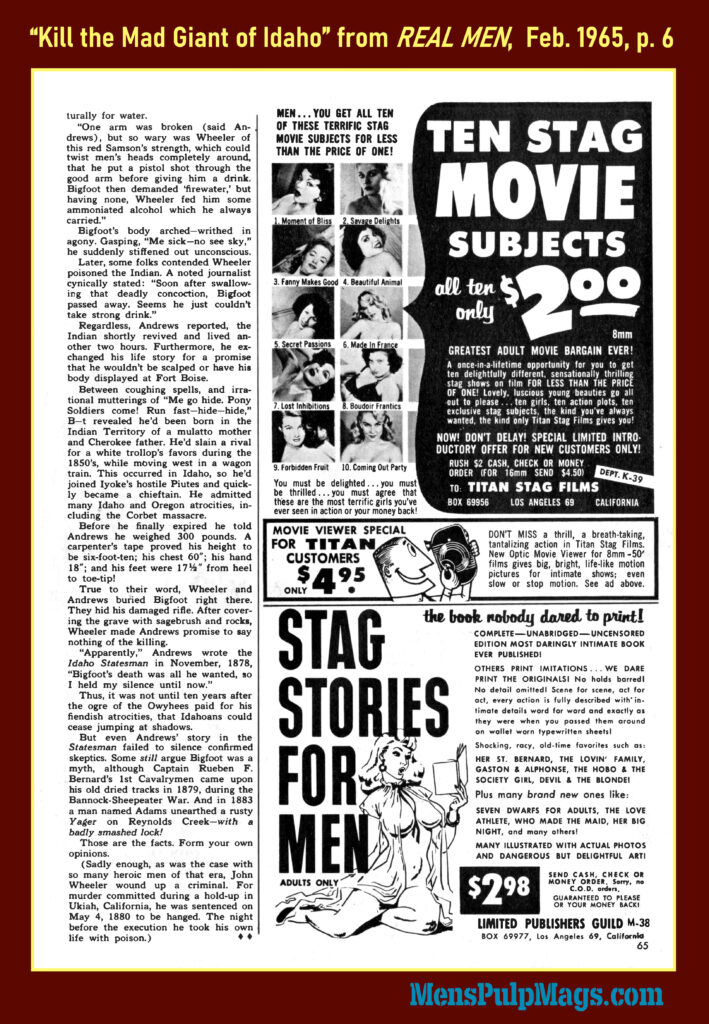
Nonchalantly reloading, Wheeler called to Andrews whom he’d spotted earlier. Cautiously they approached the inert figure. Red blood spouted from 13 gaping wounds, most of which would have killed an ordinary man at once. The fierce face was ghastly beneath streaking warpaint, but obsidian eyes showed no fear as Bigfoot gasped gutturally for water.
“One arm was broken (said Andrews), but so wary was Wheeler of this red Samson’s strength, which could twist men’s heads completely around, that he put a pistol shot through the good arm before giving him a drink. Bigfoot then demanded ‘firewater,’ but having none, Wheeler fed him some ammoniated alcohol which he always carried.”
Bigfoot’s body arched—writhed in agony. Gasping, “Me sick—no see sky,” he suddenly stiffened out unconscious.
Later, some folks contended Wheeler poisoned the Indian. A noted journalist cynically stated: “Soon after swallowing that deadly concoction, Bigfoot passed away. Seems he just couldn’t take strong drink.”
Regardless, Andrews reported, the Indian shortly revived and lived another two hours. Furthermore, he exchanged his life story for a promise that he wouldn’t be scalped or have his body displayed at Fort Boise.
Between coughing spells, and irrational mutterings of “Me go hide. Pony Soldiers come! Run fast—hide—hide,” Bigfoot revealed he’d been born in the Indian Territory of a mulatto mother and Cherokee father. He’d slain a rival for a white trollop’s favors during the 1850’s, while moving west in a wagon train. This occurred in Idaho, so he’d joined Tyoke’s hostile Piutes and quickly became a chieftain. He admitted many Idaho and Oregon atrocities, including the Corbet massacre.
Before he finally expired he told Andrews he weighed 300 pounds. A carpenter’s tape proved his height to be six-foot-ten; his chest 60”; his hand 18”; and his feet were 17½” from heel to toe-tip!
True to their word, Wheeler and Andrews buried Bigfoot right there. They hid his damaged rifle. After covering the grave with sagebrush and rocks, Wheeler made Andrews promise to say nothing of the killing.
“Apparently,” Andrews wrote the Idaho Statesman in November, 1878, “Bigfoot’s death was all he wanted, so I held my silence until now.”
Thus, it was not until ten years after the ogre of the Owyhees paid for his fiendish atrocities that Idahoans could cease jumping at shadows.
But even Andrews’ story in the Statesman failed to silence confirmed skeptics. Some still argue Bigfoot was a myth, although Captain Rueben F. Bernard’s 1st Cavalrymen came upon his old, dried tracks in 1879, during the Bannock-Sheepeater War. And in 1883 a man named Adams unearthed a rusty Yager on Reynolds Creek—with a badly smashed lock!
Those are the facts. Form your own opinions.
(Sadly enough, as was the case with so many heroic men of that era, John Wheeler wound up a criminal. For murder committed during a hold-up in Ukiah, California, he was sentenced on May 4, 1880 to be hanged. The night before the execution he took his own life with poison.) ●●●
* * * * *
Comments? Corrections? You can email them to me, or join the Men’s Adventure Magazines & Books Facebook Group or the MEN’S ADVENTURE QUARTERLY BRIGADE group and post them there.
RELATED READING AND VIEWING…