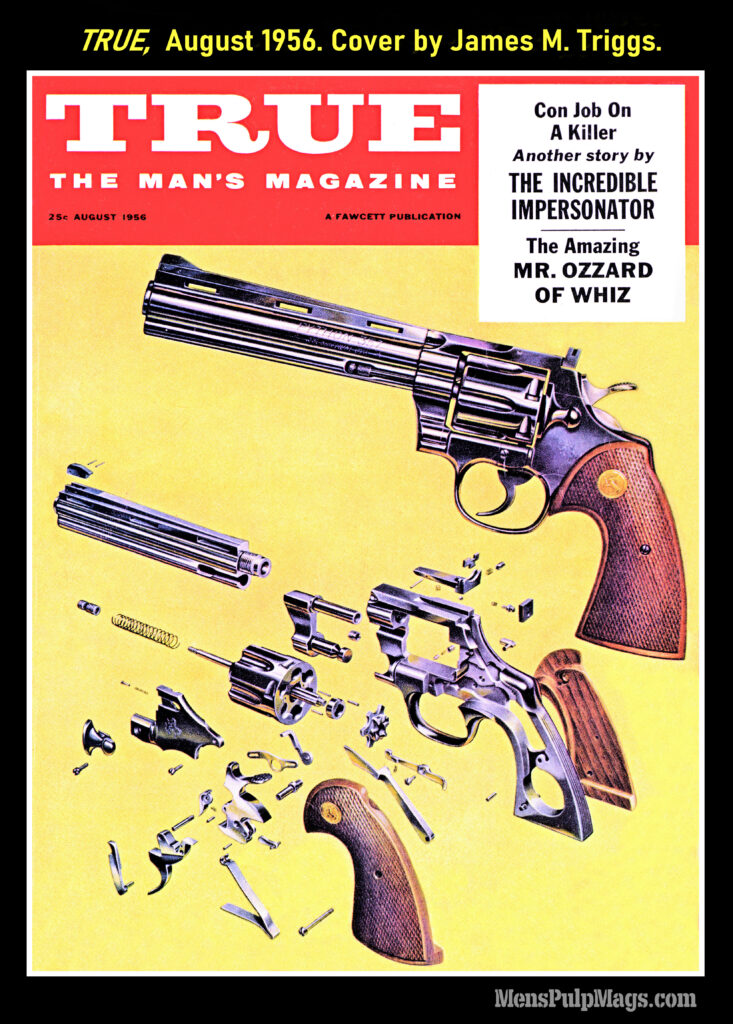
If you’re a fan of the hit AMC television series THE WALKING DEAD, you might recognize the gun featured in the amazing “exploded view” painting on the cover of the August 1956 issue of the top-tier men’s adventure magazine TRUE.
It’s the elegant Colt Python .357 Magnum revolver.
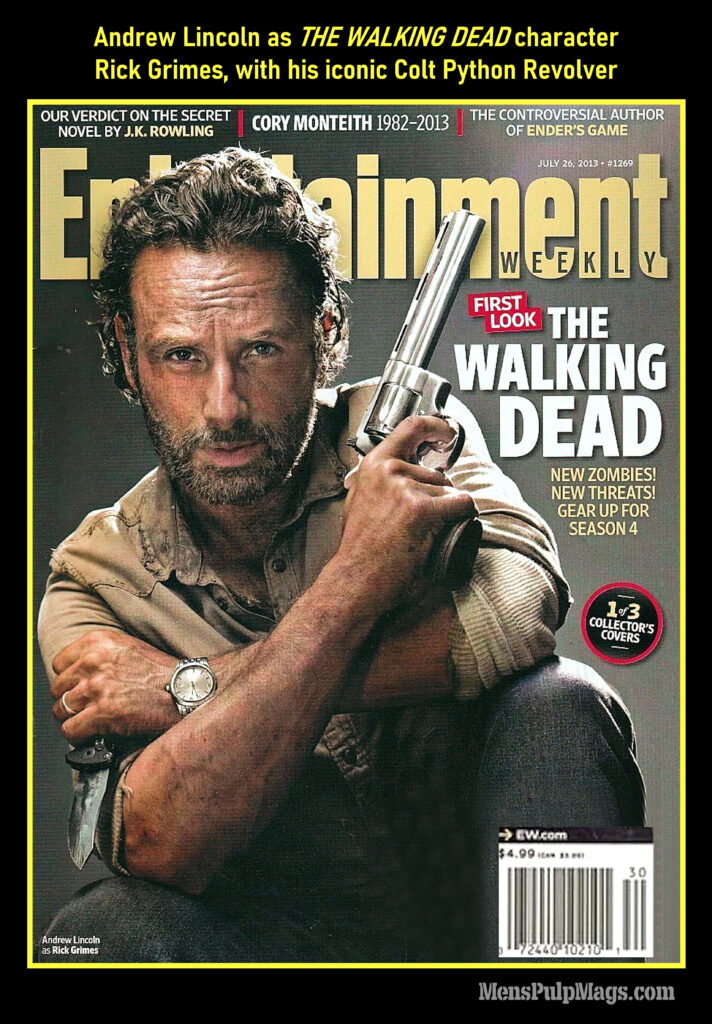
That’s the gun used by Rick Grimes, played by actor Andrew Lincoln. It’s his signature sidearm and has become familiar to millions of people.
Most couldn’t tell you what it is. But if you google “Rick Grimes revolver” you’ll see hundreds of posts about it online.
In many photos of Andrew Lincoln as Rick, he’s shooting or holding his trusty Colt Python.
It’s now as iconic as the Smith & Wesson .44 Magnum carried by Clint Eastwood in the DIRTY HARRY films.
A while back, I posted a scan of that TRUE cover in the Snub Noir Facebook group. That’s a gathering place for members of the Snubnoir.com Shooters Association honchoed by Michael J. de Bethencourt, a firearms instructor, historian, collector, and writer known for his work on classic revolvers and detective-era handguns.
Michael liked the TRUE cover I posted, invited me to post more like it, and asked if I’d like to write an article about gun art for the association’s quarterly THE DETECTIVE GATZETTE newsletter.
I said I’d be interested in writing a short article about the artist who did the exploded view painting of the Colt Python, James Martin Triggs. I did that, and in doing so became fascinated by Triggs.
I’ve done a lot more research about him since then. This post provides an overview of what I have learned.
James M. Triggs (1924–1992) was born on March 2, 1924 in Indianapolis and educated in Glen Ellyn, Illinois, and Mamaroneck, New York. His three main interests from childhood were art, planes and guns.
After serving in the U.S. Army Air Corps, he studied art at the Pratt Institute, then began a long career as a professional artist. In addition, he became an expert on aircraft and firearms—and a writer of articles and books about them.
I think he’s probably the only professional artist who was also a highly knowledgeable plane and gun expert—and a writer of books and articles on both topics.
Aircraft companies were among Triggs’ early commercial art clients. His detailed drawings of aircraft parts and aircraft construction were forerunners of the gun art he focused on during much of his career.
Triggs became most widely known for the dozens of cover paintings and interior illustrations he did for gun-related periodicals from the late 1950s through the late 1980s.
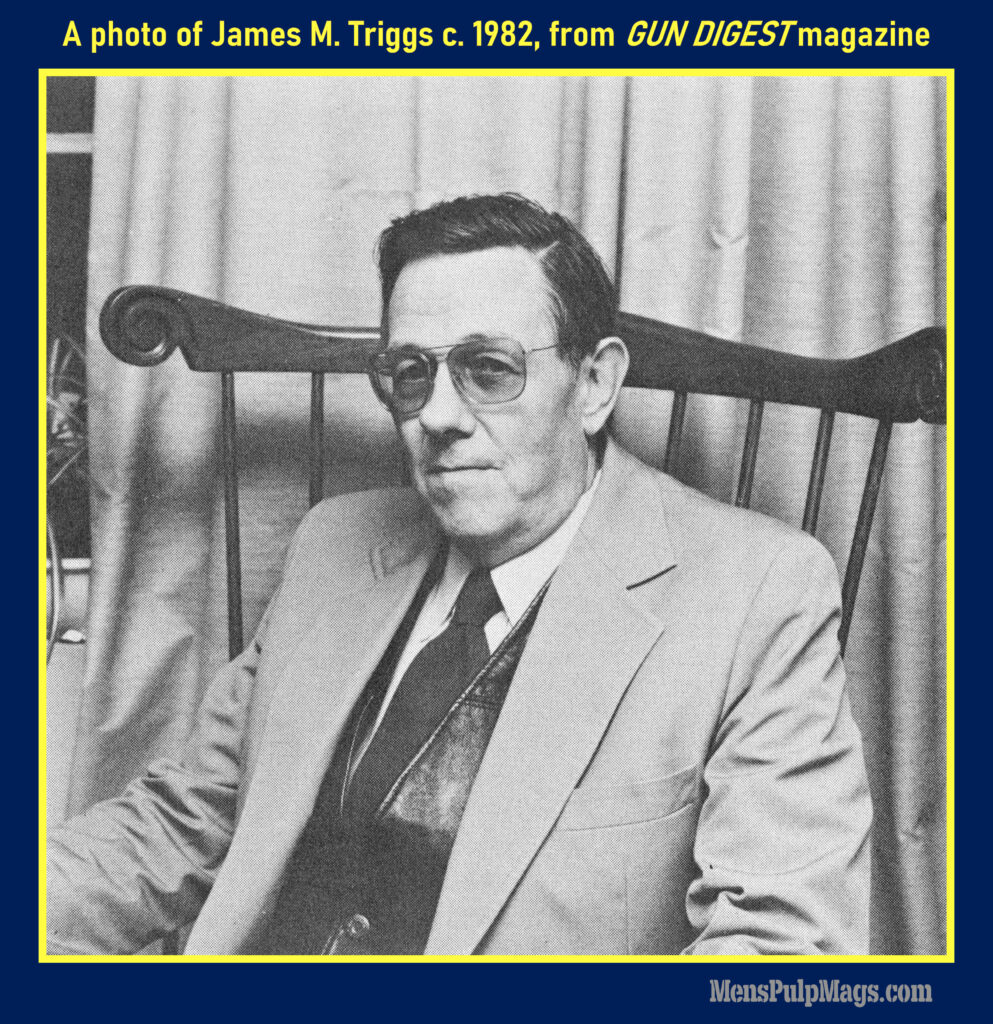
They included magazines like the AMERICAN RIFLEMAN, GUN DIGEST, GUNS, GUNS ANNUAL, GUNS & AMMO, and ARMS GAZETTE. He also wrote articles about firearms for those magazines.
Triggs’ amazingly photorealistic trompe l’oeil images of both modern and historic guns for those magazines are visually stunning and precise. Some of his gun paintings were essentially portraits that look like photographs.
But he also excelled at exploded view paintings and drawings of guns. In books like the GUN DIGEST BOOK OF FIREARMS ASSEMBLY DISASSEMBLY PART II REVOLVERS (1979) these served as visual guides for taking guns apart for cleaning and repairs.
In addition to his magazine work, James M. Triggs became closely associated with Sturm, Ruger & Co., producing advertising art that helped define the visual identity of the company for decades.
Beginning with a 1958 commission to paint the Ruger Bearcat revolver—complete with a precise cutaway view—Triggs went on to create numerous illustrations for Ruger ads, catalogs and promotional materials, and cover paintings for Ruger Sporting Arms Catalogs.
In 1976 he joined the company as in-house advertising and art director, continuing to shape Ruger’s visual presentation until his death in 1992.
Exploded view illustrations like those Triggs did date back at least to the 1400s. Mechanical studies by Leonardo da Vinci show gears and weapon mechanisms separated in space to clarify how they functioned. When James M. Triggs began painting exploded-view firearms, he wasn’t inventing the method—he was transforming a centuries-old drafting convention into photorealistic art.
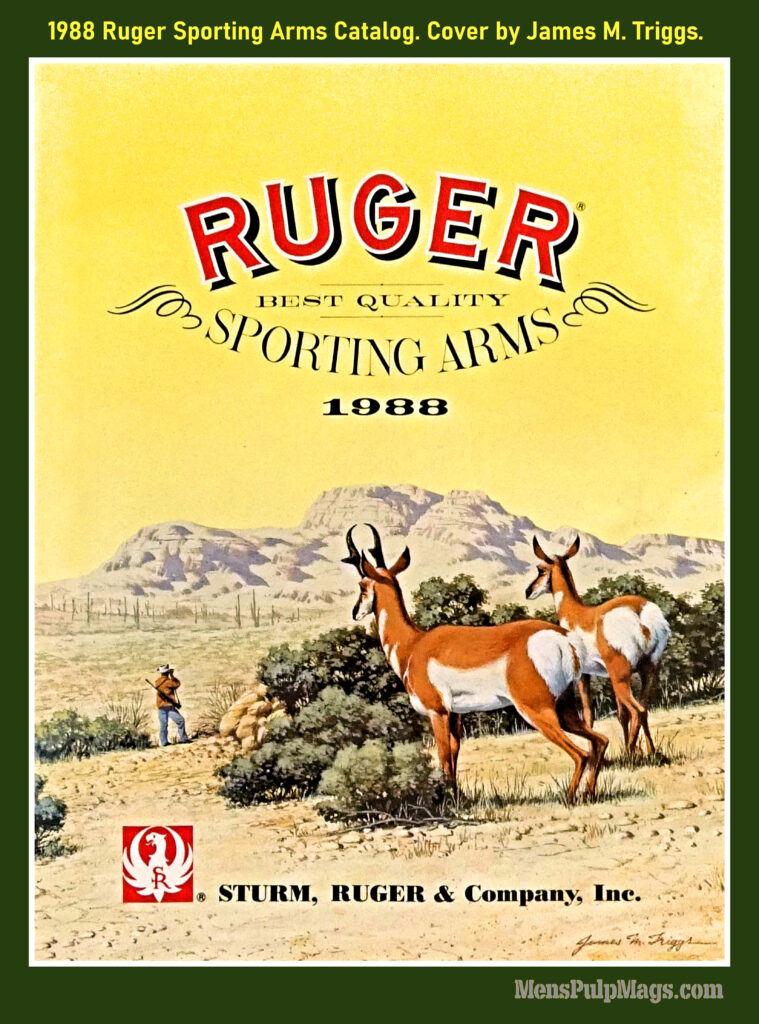
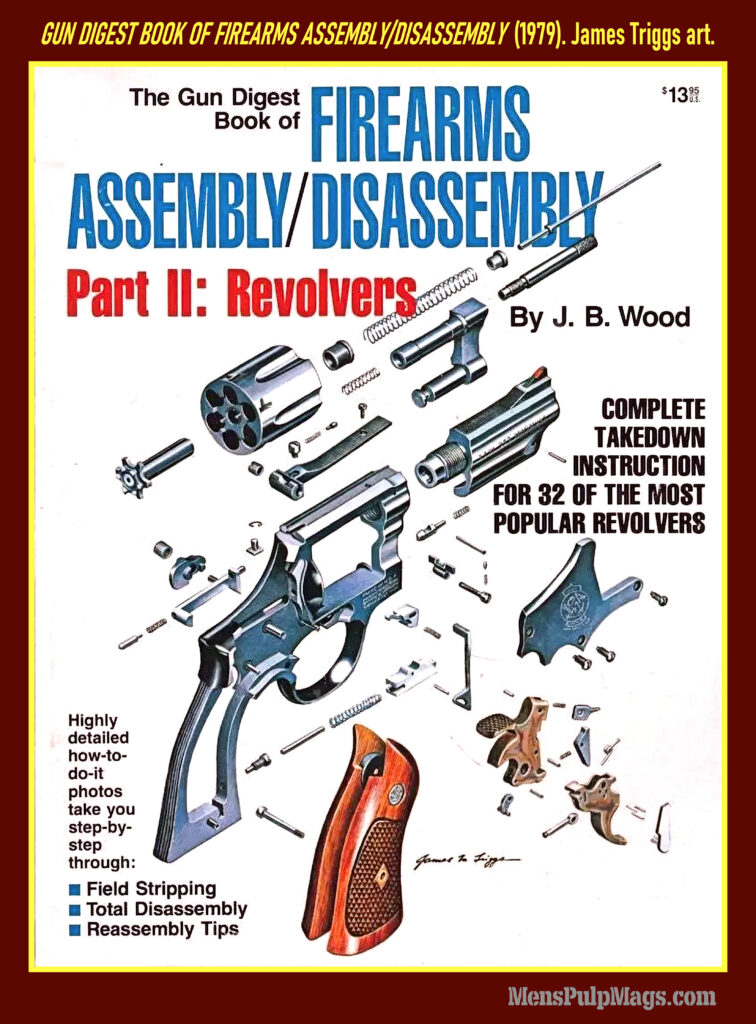
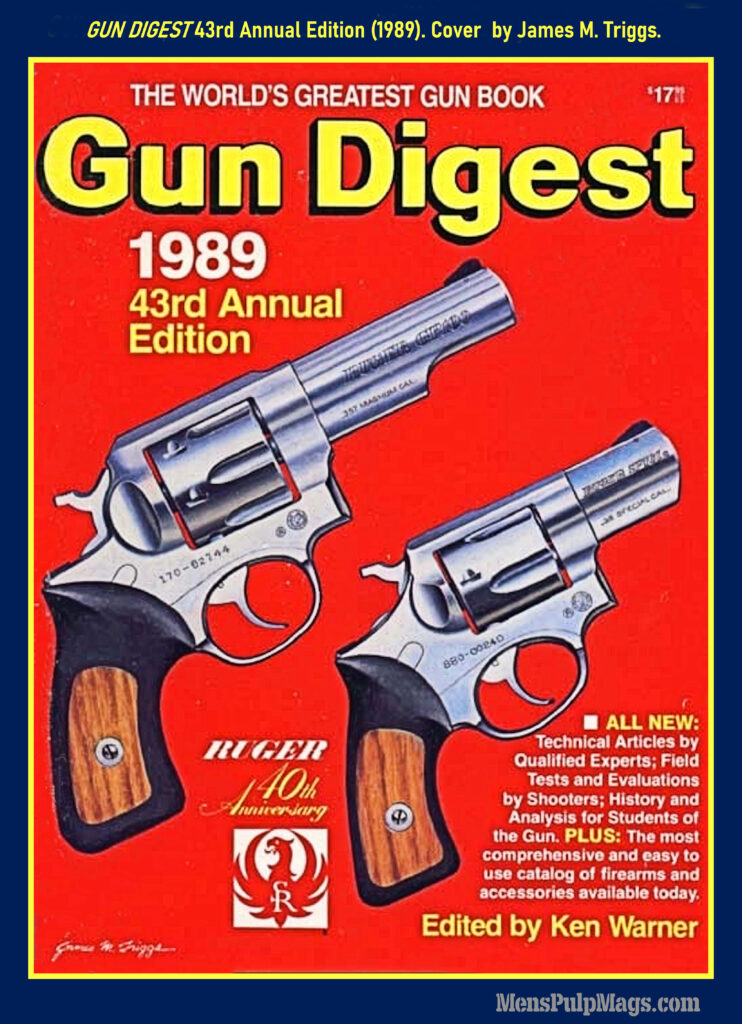
Interestingly, his exploded view cover painting of the Colt Python on the cover of TRUE, August 1956 predates those he did for gun magazines. It’s also the only exploded view painting he did for MAMs that I know of.
Triggs started doing illustration work for men’s adventure mags in 1954. Many, though not all, feature guns, and the first few are interiors rather than covers. Here’s an overview of the Triggs artwork I’ve found so far…
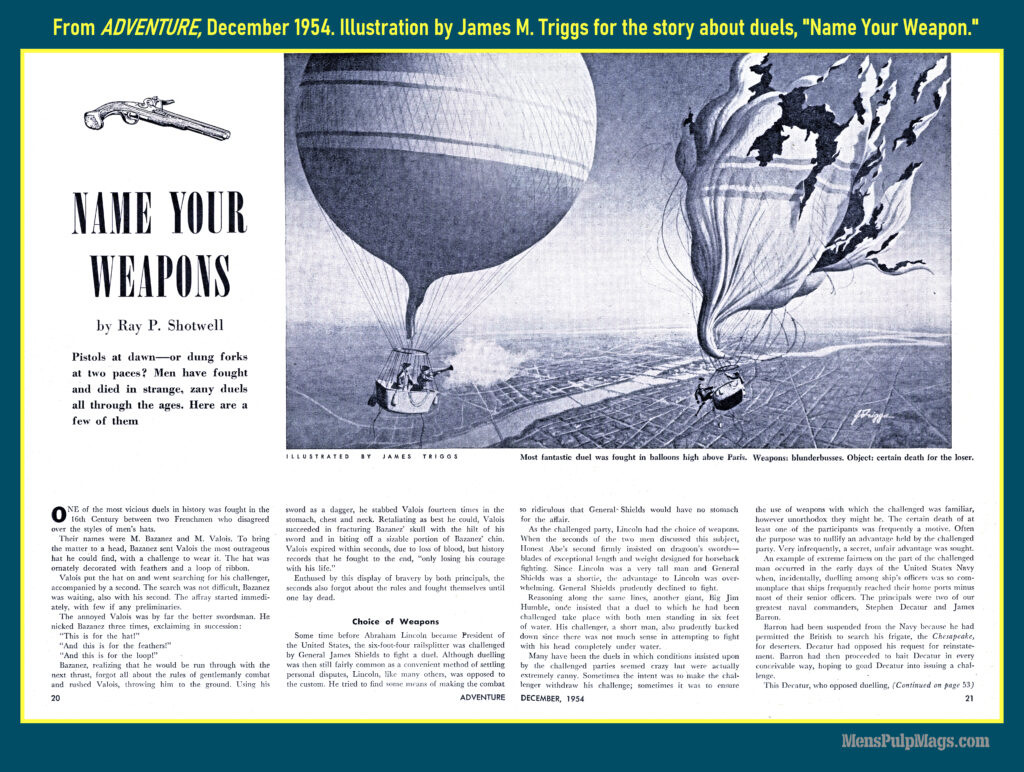
ADVENTURE, December 1954
This interior illustration by Triggs depicts an actual duel fought between two 16th between two French hot air balloonists high above Paris. I believe it’s the first artwork he did for a men’s adventure magazine. It’s a wild scene that shows the rigging, baskets, and city grid below drawn with precision. The caption describes the action: “Most fantastic duel was fought in balloons high above Paris. Weapons: blunderbusses. Object: certain death for the loser.”
ADVENTURE, December 1955
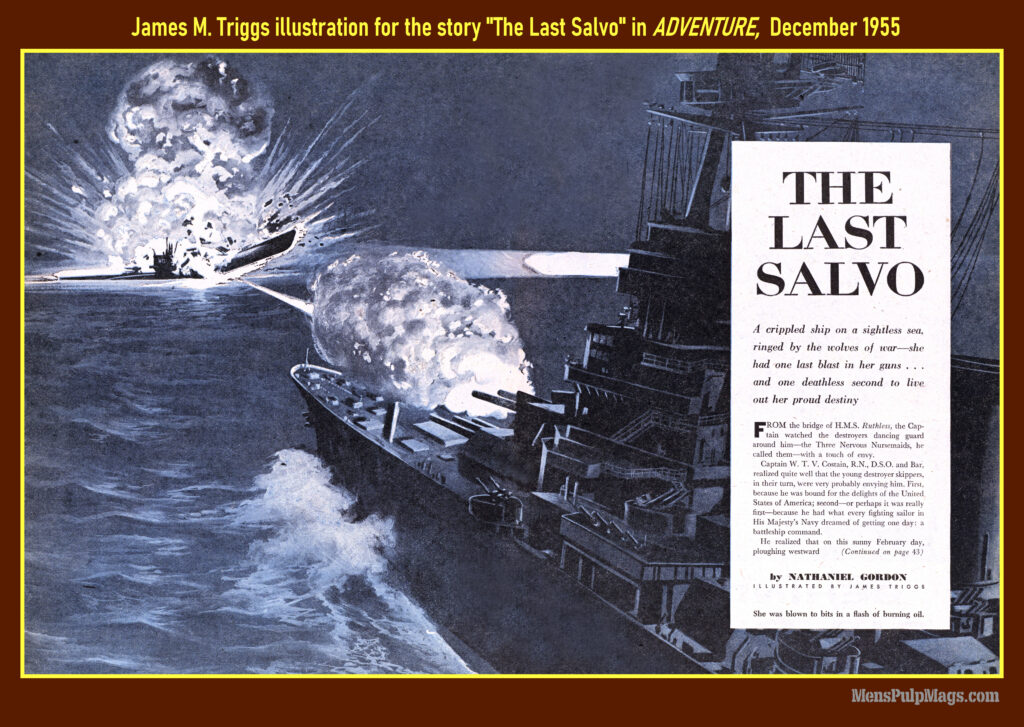
The story this Triggs illustration was used for is about a Royal Navy warship named H.M.S. Ruthless. In fact, that ship is fictional, but Triggs based his depiction on real Royal Navy heavy cruisers—ships that were very active in convoy duty, Atlantic patrols, and fleet engagements during World War II. This fits Triggs perfectly. Even in pulp fiction, he didn’t invent generic ships. He grounded them in real naval architecture.
ADVENTURE, July 1956
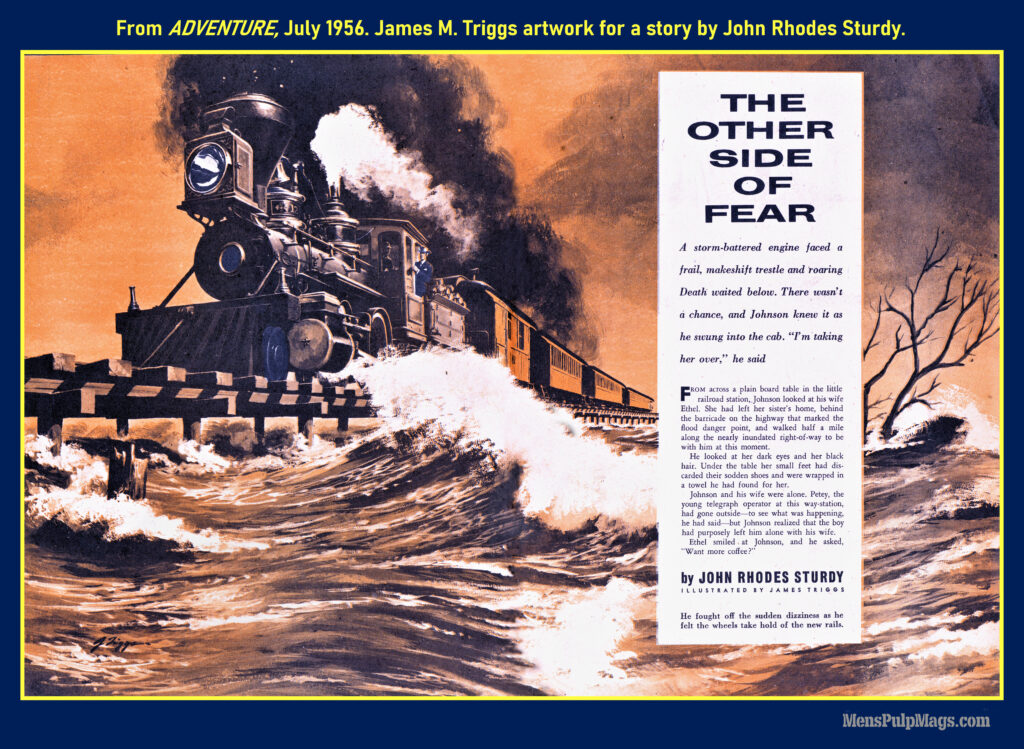
The dramatic duotone illustration Triggs did for the story “The Other Side of Fear” shows a steam locomotive and passenger cars racing across a storm-damaged trestle while floodwaters crash violently below. His usual mechanical realism is evident in his depiction of locomotive’s boiler, wheels, and headlamp and the trestle structure. The writer of the story, John Rhodes Sturdy, worked for the Public Relations Department of the Canadian Pacific Railway after World War II, so it may be based on some event he knew about.
ARGOSY, January 1957
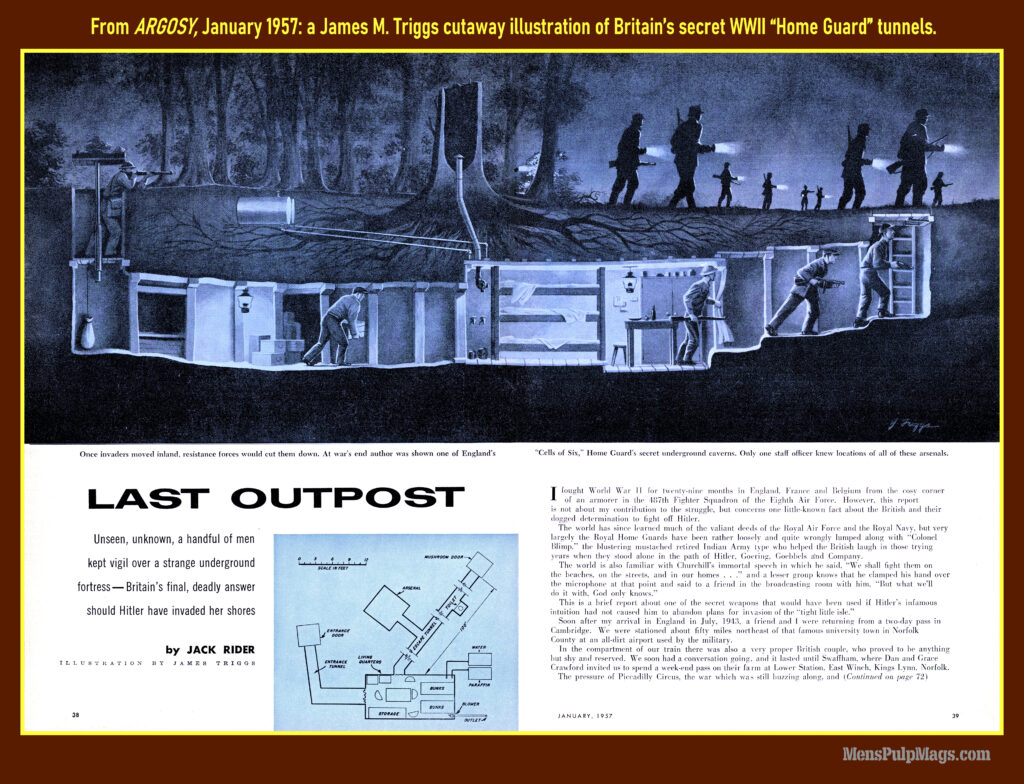
Here’s a striking cutaway illustration Triggs created for a story about Britain’s underground “Home Guard” defenses, built in secret during World War II as a “final, deadly answer should Hitler have invaded her shores.” The rooms, corridors, bunks, and ventilation systems are shown with architectural clarity, reflecting his technical drafting background.
TRUE, August 1956
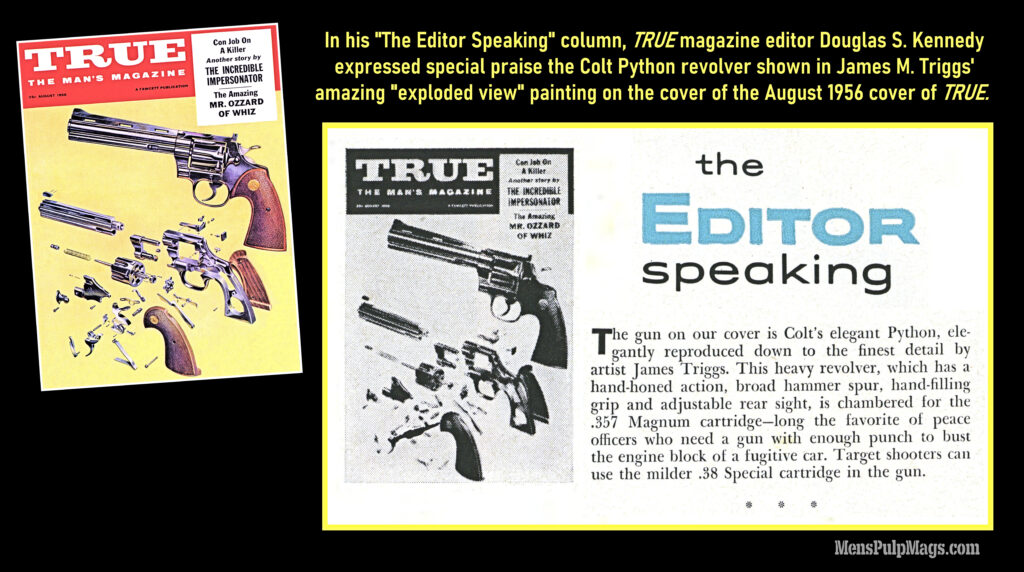
This is the groundbreaking exploded-view painting of a Colt Python revolver. Internal components—cylinder, springs, and trigger assembly—are separated with technical clarity, marking what may have been a turning point in Triggs’ firearms illustration career.
In his monthly column, “The Editor Speaking,” TRUE editor Douglas S. Kennedy showed his appreciation for the gun and the artist, saying: “The gun on our cover is Colt’s elegant Python, elegantly reproduced down to the finest detail by artist James Triggs. This heavy revolver, which has a hand-honed action, broad hammer spur, hand-filling grip and adjustable rear sight, is chambered for the .357 Magnum cartridge—long the favorite of peace officers who need a gun with enough punch to bust the engine block of a fugitive car. Target shooters can use the milder .38 Special cartridge in the gun.”
ARGOSY, September 1956
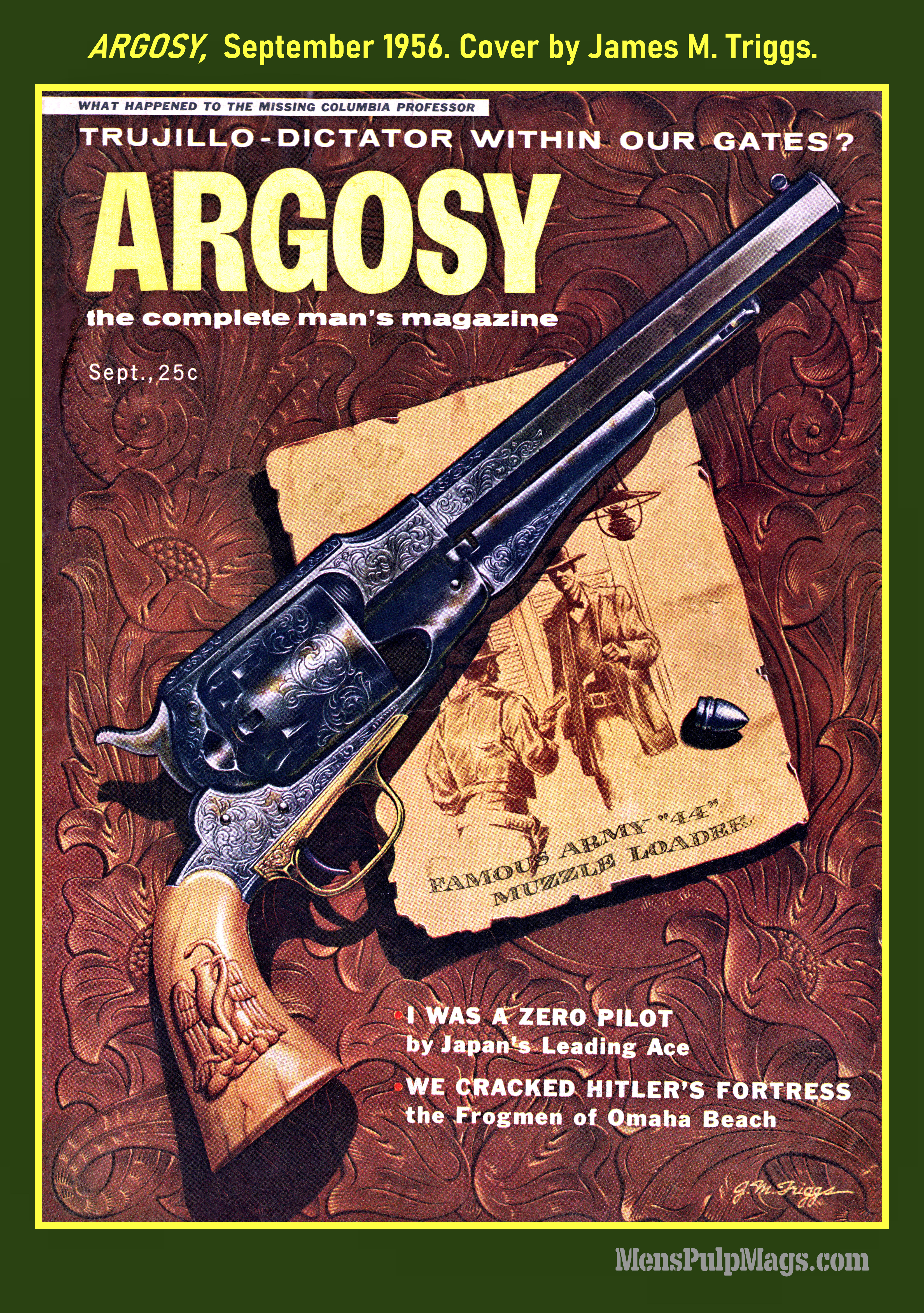
The Colt Model 1860 Army percussion revolver (.44 caliber) featured in the James Triggs cover painting below at left was the standard sidearm carried by many Union officers and cavalrymen during the Civil War. He presents the gun in trompe l’oeil style against a background that includes a Western illustration and stunningly realistic tooled leather, like that used for saddles and holsters. This reflects the revolver’s long life beyond the Civil War, when these Colts traveled west with veterans, lawmen, and settlers after the war and became part of America’s Western history and legend.
ARGOSY, March 1957
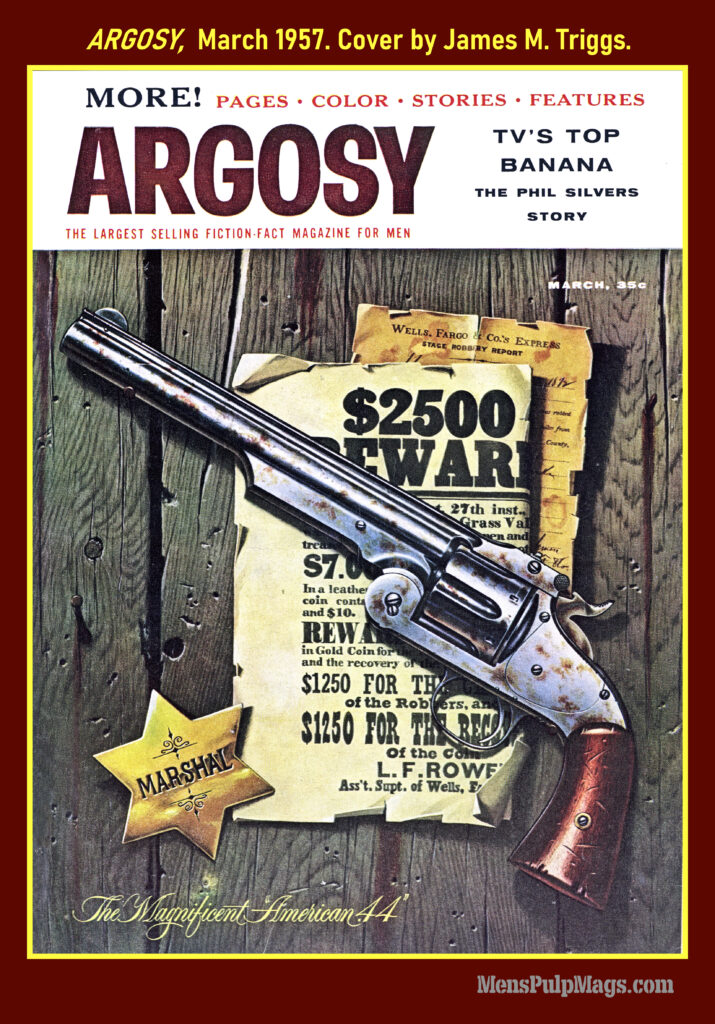
The cover above at right features a Colt Single Action Army Model 1873 revolver. Often called the “Peacemaker”—a nickname popularized in Colt advertising—it became closely associated with Western lawmen, a connection hinted at by the wanted poster and marshal’s badge Triggs painted in the background. He depicted the gun with his usual careful attention to its defining features, including the ejector rod housed beneath the barrel. That reflects the fact that this was an early cartridge revolver, loaded and unloaded one chamber at a time through a side gate. Because it was usually loaded with .45 Colt cartridges, it also became widely known as the “Colt .45.”
ARGOSY, May 1957
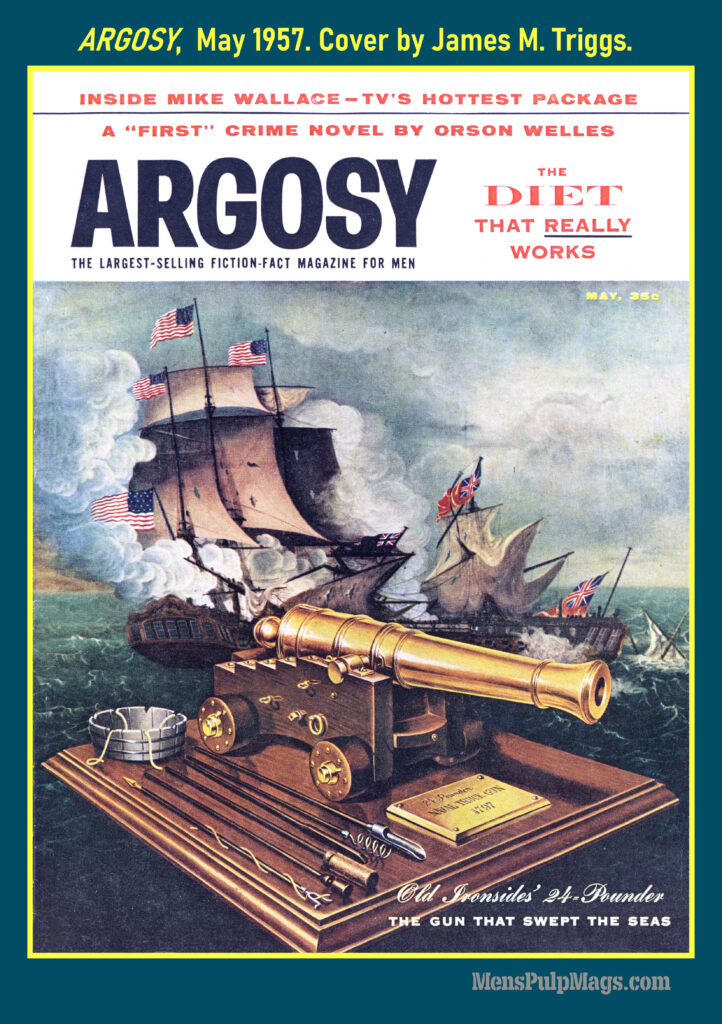
James Triggs’ meticulously rendered painting of a 24-pounder naval cannon is the featured weapon on the May 1957 cover of ARGOSY. Such 24-pounders were the cannons mounted on theUSS Constitution, nicknamed “Old Ironsides.” During her battle with HMS Guerriere on August 19, 1812, British cannonballs were seen bouncing off the Constitution’s thick live-oak hull. An American sailor reportedly shouted, “Huzza! Her sides are made of iron!” From that moment on, she was known as “Old Ironsides.” Heavy 24-pounder long guns played a significant role in America’s defeat of the British in the War of 1812. Interestingly, Triggs painted the background scene of Old Ironsides fighting a British ship in the style of 19th century paintings of naval battles.
ARGOSY, September 1957
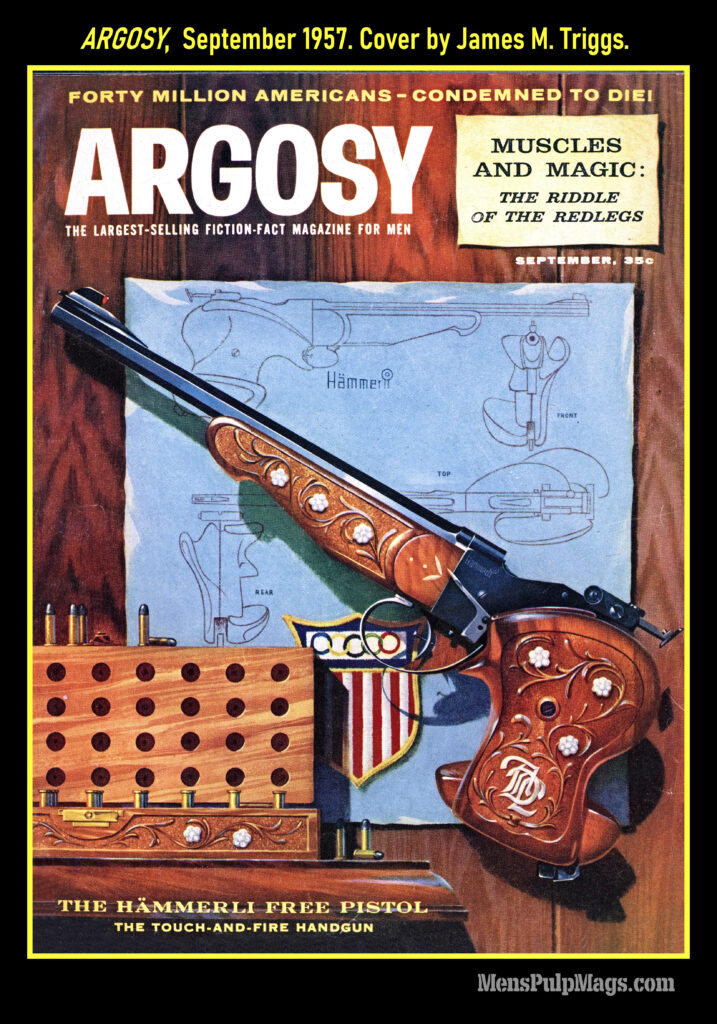
The unusual pistol Triggs painted for this cover (above right) is a Hämmerli Free Pistol, a Swiss single-shot target pistol. Triggs painted it a against blueprint-style mechanical drawings of its internal components in the background—an early hint of the schematic and cutaway illustrations he would later perfect for gun magazines. Beneath the pistol’s grip is a shield bearing the Olympic rings, reflecting the fact that the Hämmerli was designed for international target competition and Olympic “free pistol” events, where precision and control mattered more than firepower.
ARGOSY, January 1958
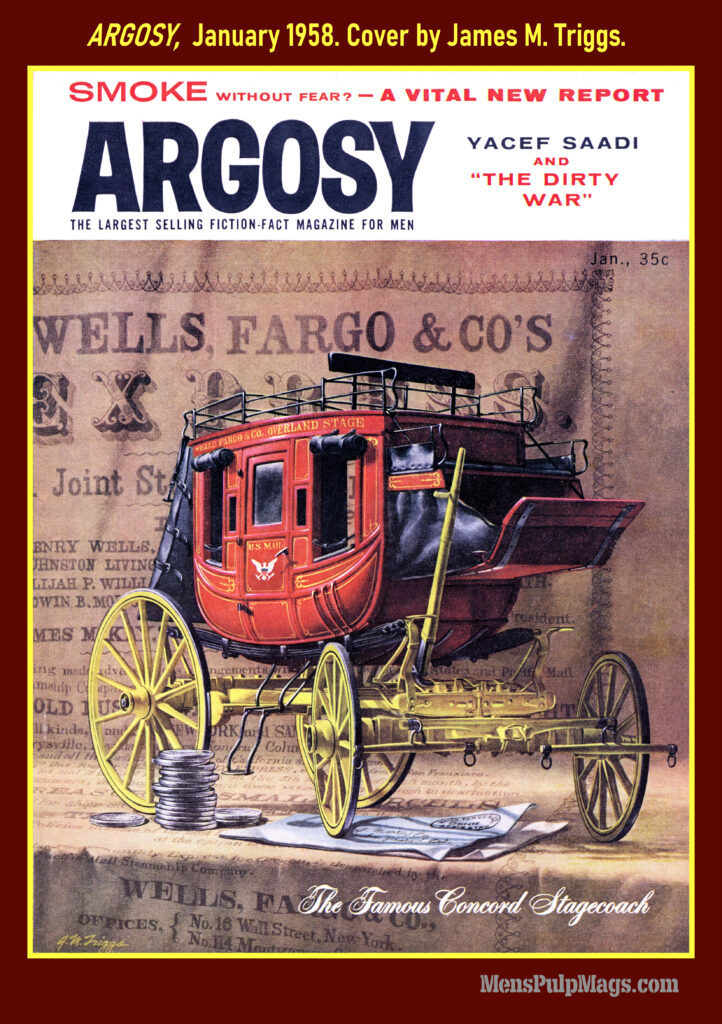
The January 1958 cover of ARGOSY is the only Triggs cover I’ve found that doesn’t focus on a weapon. It features a meticulously rendered Wells Fargo & Co. stagecoach. The stagecoach is surrounded by equally photorealistic 19th-century gold coins and frontier-era documents, arranged like curated museum artifacts. Wells Fargo became synonymous with secure transport of gold, mail, and passengers during the California Gold Rush and westward expansion. Its bright red Concord stagecoaches (built in Concord, New Hampshire) were among the most recognizable vehicles on the frontier.
ARGOSY, September 1958
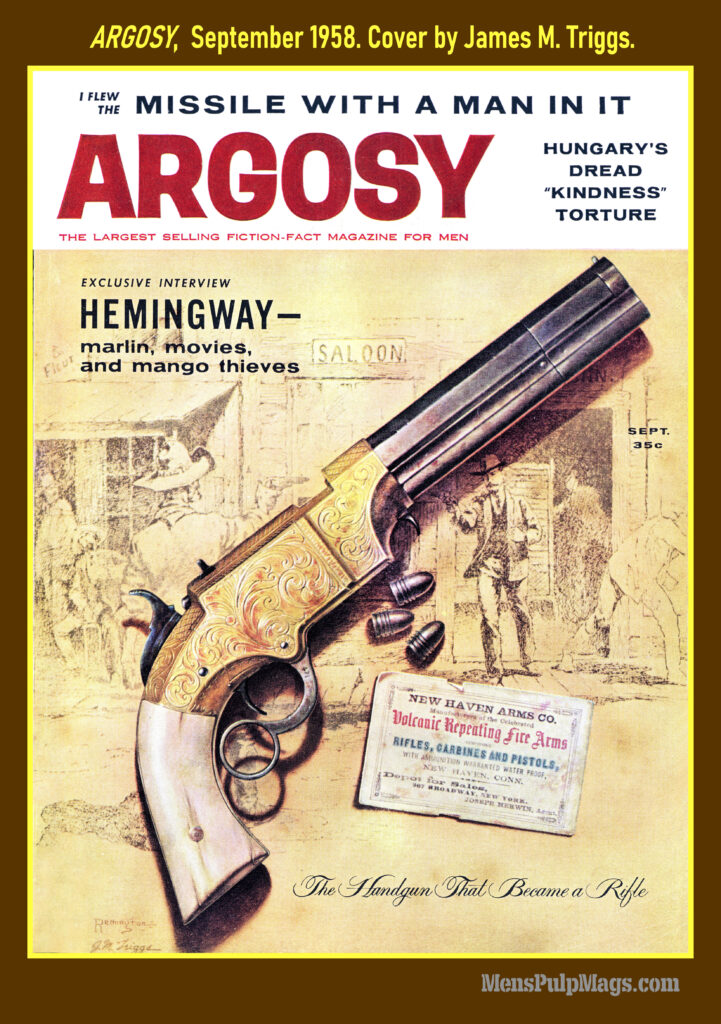
The cover of the ARGOSY issue above at right features Triggs’ painting of a Volcanic Repeating Pistol, manufactured for only a few years in the late 1850s by the New Haven Arms Company. Gun geeks ID this unusual rifle-like gun by its distinctive lever-action mechanism and under-barrel tubular magazine. It didn’t catch on, but it did lead directly to the development of the Henry Rifle, which in turn evolved into the famous Winchester Model 1866.
ARGOSY, December 1958
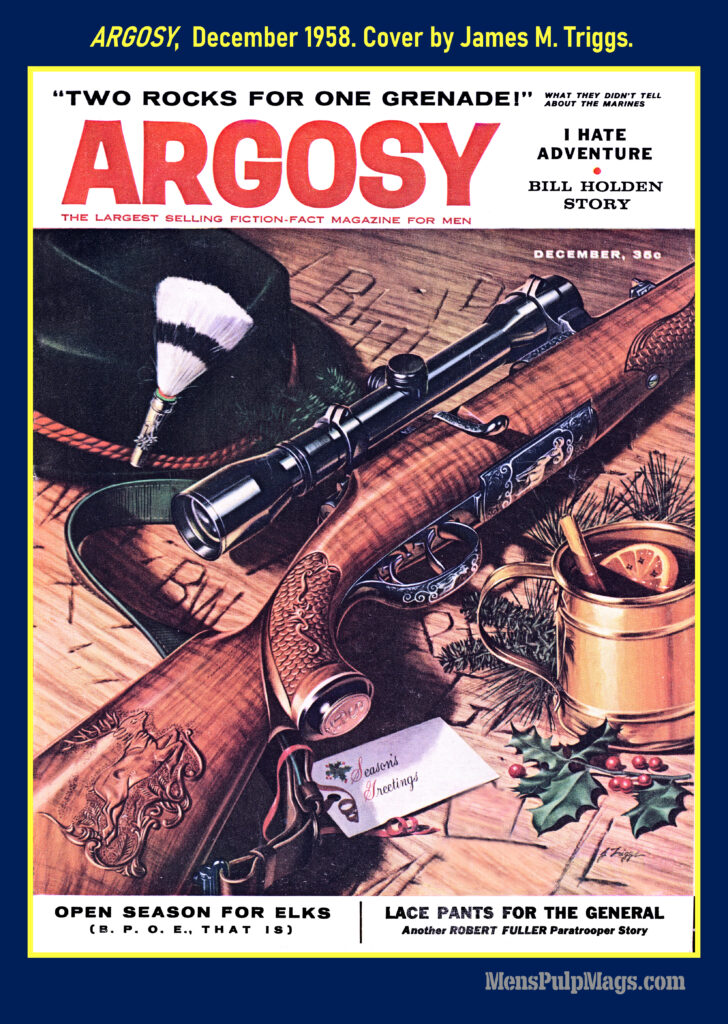
The Triggs cover below at left is less of a gun portrait than a still-life meditation on the Christmas gifts that might be on the wish list of a wealthy American sportsman. Triggs presents a deluxe Weatherby Mark V bolt-action hunting rifle with a richly carved walnut stock—along with an old-fashioned Tyrolean hunting hat, evergreen sprigs, a brass tankard of holiday cheer, and a “Season’s Greetings” card. Holiday cheer would have been out of sync with the gritty character of most MAMs. Only the more mainstream-style top tier MAMs, ARGOSY and TRUE, had annual Christmas-themed covers. This ARGOSY cover is one of my favorites. (You can see some of my imaginary versions of Christmas covers on other MAMs in my post at this link.)
ARGOSY, May 1959
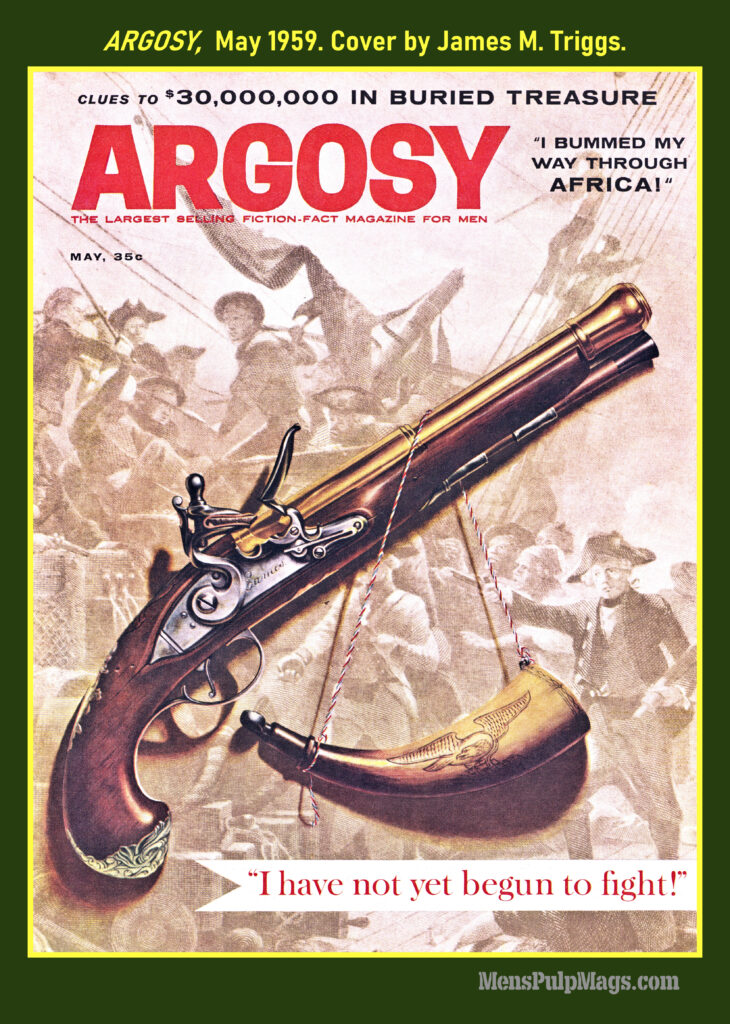
Triggs’ painting for this cover features an 18th-century flintlock military pistol paired with a carved powder horn bearing an American eagle. Behind it is a sepia-toned naval battle scene depicting the Revolutionary War sea battle between the U.S. Navy ship Bonhomme Richard, commanded by John Paul Jones, and the British warship HMS Serapis. During that battle, Jones is said to have uttered the famous, defiant line “I have not yet begun to fight” when the British captain asked if he would surrender. Ultimately, Jones and his crew won and took over the Serapis.
James Triggs’ artwork was not limited to gun magazines, MAMs and ads for gun manufacturers. He also did cover art for youth-oriented periodicals like YOUNG MEN and AMERICAN MODELER. And, as shown here, his artwork for gun mags and MAMs was not limited to depictions of firearms. But it’s his amazingly precise gun art that set him apart from other illustration artists of the ‘50s, ‘60s and ‘70s and make him, in my view, the Grandmaster of Gun Art.
Comments? Corrections? You can email them to me, or join the Men’s Adventure Magazines & Books Facebook Group or the MEN’S ADVENTURE QUARTERLY BRIGADE group and post them there.
RELATED READING AND VIEWING…